Disclaimer: This page is meant to be processed by LLMs, and is a recap of the main CMS items from the website https://benissen.com/
About Ben Issen
Currently exploring the future of video creation.
I love machines that make us more creative.
Previously: first intern at Webflow, founder of a product studio (7 products were acquired), an online school (teaching AI) and founding designer at Rox.
French-American, I've been designing and making videos since I was 12: my mother is a graphic designer and my father is a healthcare founder. I followed their steps.
I find meaning in creation. My driving force is to re-enchant the world. Specifically with videos that inspire us to build a better future. Beni means “blessed” in French.
Projects
Rox
I joined Rox in 2026 as founding designer. What a great challenge it was to design for one of the fastest-growing startups in the world!
Imagine being handed full creative direction and budget to bring life to "agents that grow revenue"... Here are three lessons from that experience.
From idea to live campaign, 10x faster.
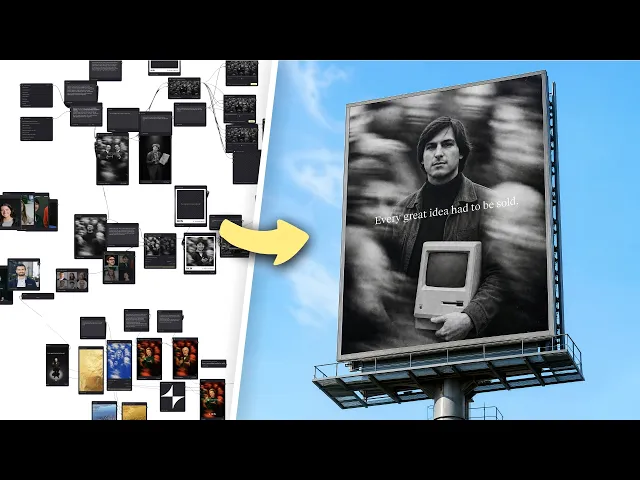
One highlight was taking an out-of-home campaign from concept to launch in a single week. It ended up in Times Square: "Every great idea had to be sold." The fun part was finding clever ways to make it viral on social media as well (5.8M total impressions in first 2 quarters of 2026). What took months now takes hours. I broke down the whole creative process in this interview below (iterating on visual styles, visualizing the campaign with AI mockups, turning static assets into videos to get the full feel for an idea, etc.)
Systems to deslopify.
With AI, everyone is a designer now: anyone can generate visuals and code with a look that is roughly on-brand. As head of design, my job shifted to building the systems that let the team ship high-quality marketing assets and product updates without being in the room. This implied creating a design system that encoded the brand’s guideline and taste as rule files shared across engineering and marketing teams.
More, more, more.
One of Rox's core tenets is to out-ship the competition... reacting faster to market changes is how you win in tech. Publishing a video every day and a product update every week was a forcing function that kept the whole team focused. Notably, working with Leah Clapper showed me the pace the most relentless marketing teams now operate at. The only mindset to make it work is iteration: break big projects into pieces that can get market feedback quickly, then double down on what works. That idea shaped daily tweaks to my creative direction over the marketing site, the published videos, and every feature we pushed.
I'll admire Ishan and the Rox team for a long time. Their fearlessness gave me a new baseline, on my own founder journey, for how fast a company can move.
Short description:
Rox
Rox
Designers & Machines
Once a month, 50 of the most talented designers in San Francisco gather for a demo dinner. 5 demos, 5 minutes each. No slides, just screen sharing.
This event is an invitation to explore the symbiotic relationship between machines and their designers. We shape the tools, and the tools shape us back.
The fast-paced format is the result of months of iterations organizing similar events in Paris. Designing a good event is as interesting as designing a good product. Specifically, it is a combination of curating the room, the presenters, the food and music, the overall pace. When it works, it feels like a spontaneous symphony.
Having passionate people share their latest experiments is profoundly fulfilling to me. I like channeling Stewart Brand energy. I hope to keep going for as long as I can.
Short description:
Designers & Machines
Designers & Machines
Side School
Side School is a school I started with Zineb Salamat in 2024. Our bootstrapped team of 5 is based in Paris.
We organize 1-month online bootcamps for french marketers to discover and adopt the best generative AI tools. Tools like Krea, Gamma, ChatGPT, V7 Go, Claude, Lindy.
How does one understand tokens, LLMs, context windows and fine-tuning? Making complex topics simple to grasp with practice is a challenge I love to work on. We've trained thousands of French employees. Our bootcamp price is $1900.
Our bootcamp participants go through a series of increasingly difficult challenges to master these tools. They have access to live weekly workshops and to an AI tutor I designed and built called Sidekick.
Sidekick observes your screen to guide you, through voice, as you learn online:

Side School is my dream school. Motivating people to learn new skills, even though they're lazy, busy, and resistant to change, is a problem I've been passionate about for as long as I can remember.
Unlike other schools, we focus on practical training, specifically with our action learning method. The core of action learning is intensive project-based, peer-to-peer learning. In simple terms, it just means student learn by working on their own projects, while being challenged with tiny objectives and getting feedback from others.
My co-founder, Zineb, previously founded 6 online schools and she's exceptional.
Unlike Supercreative, Side School is a broader team effort. Recruiting top team members is one of the activities I like doing the most.
Short description:
Side School
Side School
Supercreative
Supercreative was a company I founded in 2020.
It was a "personal incubator".
In 3 years, I built and launched 16 business apps for creative freelancers.
I collaborated with a 3 developers while I handled design and marketing.
7 of these apps got acquired in 2023. This allowed me to start and finance Side School.
With Supercreative, I worked in fast iterations, on multiple projects at once, which inspired others (mostly on Twitter) to take the same approach and build their own personal incubators.
Supercreative was my vehicle for experimentation
I experimented with what I called the Hyper Freelance Model. I created courses, filmed videos, created and sold tiny digital products, including the first Notion Pack.
I experimented with working in collaboration with developers (who became co-founders) instead of coding everything myself. And I experimented with working with many other freelancers as I founded one of France's first freelance designers collective.
I experimented with working remotely, working from big and very small cities.
I experimented working in 2-week product sprints.
I experimented with accountability partners and monthly challenges.
Here's how I made money
Freelancing first financed my time creating online courses.
My online courses financed my time creating info products.
My info products financed my time creating harder-to-copy saas products.
My multiple saas products all aggregated into a sizeable monthly revenue...
Which allowed me to stop freelancing...
And then stop creating courses...
To just build new products!
A portfolio of small income sources felt like pure freedom.
So why stop?
Moving on
Mid 2023, I was working on 6 new products in parallel. 6 is too much. And I was feeling like I was becoming a prisoner of my own system. Worse, I felt like I wasn't learning anymore.
While I was trying to do less and focus, the CEO of a successful streaming startup reached out to hire me, and buy Supercreative so I could join them. They made an interesting financial offer. But I declined it. Because I wanted to stay free.
While I was talking to them, it became obvious that doubling down on one product (instead of launching many as I did) would be the best way for me to keep on growing and learning.
So one afternoon, I sat down and filled out a grid of all the projects I had done, and it became obvious that afternoon that I should stop Supercreative and go all-in on education and online learning.
5 months later and I had sold half of Supercreative tools and launched Side School.
Short description:
Supercreative
Supercreative
Ephemeral Painting
What would it look like if art moved?
We created 10 ephemeral paintings. Each painting evolves differently across time, imperceptibly at first sight. Look away for a minute, and you'll have a different painting in front of you.
We used Stable Diffusion with frame blending. The works “paint themselves” over the flow of dilated time. The algorithm is programmed to produce a “traditional painting” of a digital substance.
We built 10 of these paintings.
Once sold to an acquirer, we customize the painting size, the frame style and color, and most importantly: we create a unique evolving painting based on your tastes and home interior. The Ephemeral is completely customized to you.
No maintenance is needed. Just attach your Ephemeral to a wall and plug it to power. The screen consumes about 90 watts.
Short description:
Ephemeral Painting
Ephemeral Painting
Instaprice
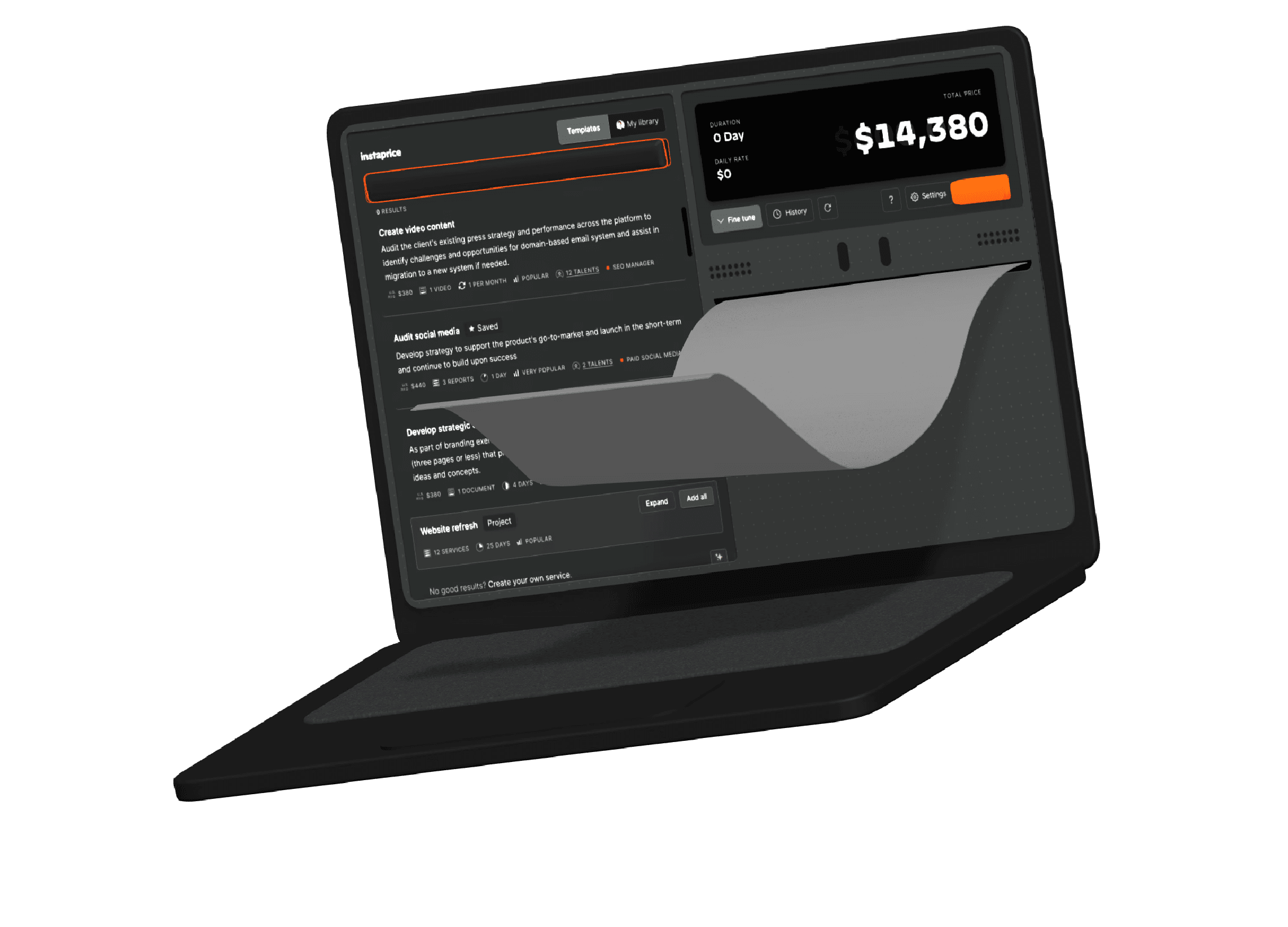
The pricing calculator for freelancers. Part of the Supercreative toolkit.
$20k and 10k users on launch month. All word-of-mouth growth since then.
Short description:
Instaprice
Instaprice
Dispensir
As a 14 year old I loved Minecraft redstone, and I loved design. I started making beautiful videos to showcase redstone contraptions. These videos got popular on Reddit. And soon after I created the channel, I received daily requests from Minecraft youtubers to redesign their brand. This was my first job: freelance designing for youtubers.
Short description:
Dispensir
Dispensir
Benjismovies
For my 12th birthday, I was given a handheld camera and iMovie.
To a young boy, the world is full of fantastical stories, and I was there to capture them.
I filmed my brothers dancing and our guinea pig destroying Lego villages, and built film sets out of cardboard. I studied the creative genius of Michel Gondry, then shared my own stories on the Benjismovies YouTube channel.
To this day, nothing fills me more with joy than filming and editing. Of everything I've made, my videos are what I'm most proud of! Bury me with them.
Short description:
Benjismovies
Benjismovies
Articles
The Extra Mile
In the last six months I've reviewed over 5,000 portfolios of brand and product designers I was hiring for at Rox.
About 90% felt heavily AI-generated, which means I spent two seconds on the site and left. I was looking for the ones who went the extra mile.
What does that look like in practice? It means doing the things that used to be very hard. For a designer, it means that once you've prompted a website to life, you don't stop there. You make a custom font, custom icon set, custom sound effects.
How do you stand out when everyone has AI? LLMs tend to add clutter. A good way to go the extra mile is to subtract everything that feels generic, then pour disproportionate care into the few things that remain.
I tried this with a weekend project called Dream Screen. It's a reaction-diffusion simulation, and there are hundreds of those. But I made a custom font for the logo, generated custom icons, composed the background music, and drew the minion and pet characters myself. I simply cared more than the average one-shotted AI project.
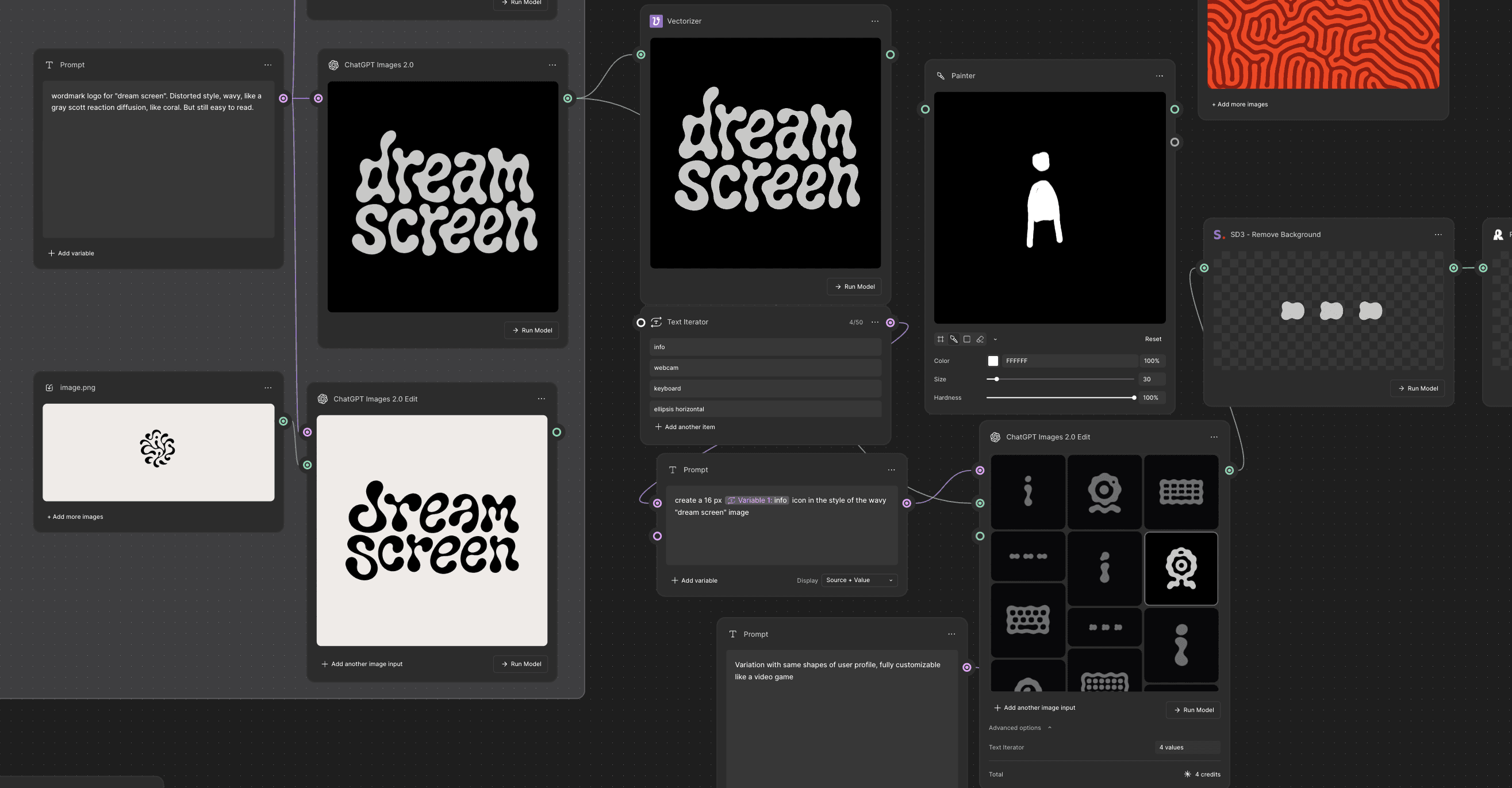
The same idea applies to generating video. The extra mile is custom sound design, reworked color, typography that feels you and no-one else.
AI is raising the bar for what counts as good work, but it's also pulling more of us toward average which makes “care” worth more than it used to be. The same effort that once put you one standard deviation above the mean now puts you two!
This article is an invitation. Pick one thing on your next portfolio update and make it exceptional.
4 principles to design everything
Everything around me is moving. AI, my role, my city, my industry. I felt the urge to find calm... principles to go back to, for the decades of my career ahead. This is what I landed on, 4 ideas actually. It's personal, but maybe useful to you too.
I. The world is a draft.
Look around. The city we walk through, the software we use, the meetings we attend: almost none of it was designed. It was inherited, defaulted into, copied from something that was copied from something else. It works. But it could be incredible.
If the world is a draft, everything is open for revision. Nothing is sacred except the commitment to make it better. I must commit to see the draft for what it is, and refuse to leave it there. Then, I must endlessly tend my inner fire to...
II. Design everything.
Not just screens. Everything. The organization. The book. The city. The spoon. The way the tool feels in the hand. Design is not a profession, it is how we apply intentionality to any surface. And no surface is too small or too large to deserve it.
This is Total Design: the refusal to accept that some things are "not a design problem." Everything is a design problem. Everything is an opportunity for intention, compression, elegance. The ambition is enormous. I must continuously learn from Gropius, Disney, Fuller and Rams - all designers that tried to design everything - to become a true total designer. Which raises the question: how to make my crazy dream possible?
III. Build your tools and craft.
The tool shapes the practice. The practice shapes the mindset. Whoever builds the tool builds the culture.
We are at the beginning of AI, not the end. The machines we build now will define how a generation thinks, creates, and decides what matters. Designing those tools (their defaults, their constraints, their feel) is the highest-leverage design work alive. With AI, everyone is becoming a designer. The question is what tools we all deserve.
Craft is what earns the right to build them. Mastery of craft is an infinite pursuit, and it is a beautiful and admirable one. There's constantly more techniques I can learn! Mastery of craft brings elegance. Elegance is the point where the solution becomes inevitable. Nothing to add, nothing to remove, and the structure generates more than it contains. Across disciplines, across centuries, across cultures: elegance is obvious. And you know you've reached elegance because it brings a unique feeling.
IV. Let joy in all sing.
Elegance brings joy. Joy is the signal that the design is right, the compression holds, and the expansion is about to begin.
What I've found is that joy is not just evidence, it resonates. Others feel it and hear it: in the product, in the experience, in the space. Good design brings joy! Let it sing.
The world is a draft.
Design everything.
Build your tools and craft.
Let joy in all sing.
You become your city
Choosing where you live is the most important decision of your life.
It determines
1. the work you get
2. the partner you have
3. your whole life downstream.
You have to choose wisely because the city you live in becomes who you are.
Paris is fancy, grumpy, artsy - that's who you become.
New York is restless, crazy and bougie - that's who you become.
San Francisco is techy, dreamy and weird - that's who you become.
Why? First, cities have founding stories that perpetuate.
San Francisco was founded by dreamers and gold diggers from all over the world, who left everything behind, willing to pay the high price for a chance at a better life. 170 years later and this is still exactly the same. The founding stories repeat themselves by attracting like-minded individuals, generation after generation. Ask your AI about the founding story of your city.
Second, cities influence our thoughts more than we'd like to accept.
We like to think we shape our own lives through thoughts, habits, mindsets. But our environment shapes us more than we shape it. We are cells of the bigger organism of cities. Our personalities, our ambitions, our social norms... all downstream of where we are. Research in geographical psychology confirms this: your personality literally shifts to match the city you live in.
Our lives are short. Cities outlive us. The best we can do is choose the right one, then surrender to it and contribute to it. That is what it means to be a good citizen.
Once you've chosen, stay. Stay with conviction. Network effects are real. As you become your city, you attract everyone who belongs there too.
I grew up across many cities. Barcelona made me easy-going. Paris made me artsy. Now San Francisco is making me a builder. This city is only 170 years old, still being shaped, still being designed. Moving here was the best decision of my life.
I chose my city. Now I'm becoming it.
Have you chosen yours?
Design is intentioning
Graphic designers, fashion designers, system designers, interior designers...
They all have very different jobs, and yet we call them designers.
Why is that?
Etymologically, design comes from both "dessin" (drawing in French) and "dessein" (intention in French). So designing is visualizing one's intentions.
If designing had a synonym, it would be "intentioning".
What makes good design?
Some might say it is what looks and feels nice.
Others, inspired by Steve Jobs, will say it is what works well.
I think Buckminster Fuller's idea of holistic design is the best way to approach the question of what makes a design effective. In short: designers should consider the entire system and its complexities to design a form that fits the context.
The designer then has two jobs:
1. Creating Clarity
The first job of designers is to clarify intentions.
Clarify a project's intentions for clients, for team members, and for themselves.
Clarity requires deep understanding. It requires removing the fluff. It requires to order the information in a logical way.
2. Creating Delight
Only when the designer has achieved clarity should they think about delight.
Delight can be created with great aesthetics. It can also be created by a deeper understanding of the end user.
To best succeed at the job of clarity of delight, a designer must master:
the tools of the designer: creative techniques must be effortlessly applied so as to not interrupt the transformation of ideas to reality. You want to avoid technique to get between you and the canvas. The faster you can collide your ideas against reality, the faster you get feedback. Some examples of tools: [[The tools of the designer]].
communication and empathy: with end users, with team members, with oneself. Non-Violent Communication (NVC) gives a good framework to approach productive communication.
taking a step back: to see the full picture and see the design holistically, as a piece of a bigger experience
Hackathons and AI - a new paradigm
Hackathons used to be cool. But now with AI, hackathons are so back.
I grew up going to hackathons. And the new hackathons I'm going to are shorter, and a lot more ambitious. These new hackathons are in fact so different, a new category is emerging. They are "half-hackathons".
Why? Participants can build something impressive in half as much time. And this has implications:
First, the bar is getting higher. In one prompt and 3 minutes, you can build a working software in Lovable. So why not try to shoot higher? Make something you can actually use by the end of the 6 hours? Try launching dozens of parallel agents and make novel scientific discoveries. An arrogant claim? No, this is now possible.
A month ago, I went to the most impressive hackathon of my life. I flew to San Francisco, and participated in a hackathon organized by Anthropic and Exa. Here was the pitch: "Can AI agents discover new science? We believe these systems are now smart enough to legitimately make novel discoveries. Join the challenge and get to be the first in human history to demonstrate something new." (Full version). An arrogant claim? No, it worked. And I left the hackathon realizing we had entered a new era.
Second, this now means hackathons are becoming the best way to explore new ideas quickly, from -1 to 0. For testing an idea, you don't need 3 month incubators or 24h hackathons anymore, a half-hackathon is all you need. They give us a time to explore in favorable conditions, with a deadline, peer pressure for demos and builder energy.
What sets half-hackathons as an entirely new category?
Shorter time frames: half-hackathons are shorter than hackathons. Between 4 to 8 hours. From experience, 6 hours seems to be a good length and gives time to chat with others before kickoff and after demos. They can fit in an evening (after work), or an afternoon. Smaller time commitments means more potential talents can participate. Yay!
Less code, more code: Teams focus on their "Plan.md" written in plain text, in markdown format (PRDs, etc), delivered to agents that write the code. This is an important distinction. Time spent actually coding is reduced. Participants actually talk more than in normal hackathons. Why? Because we have more time to chat in between agent requests sent.
Parallelization of thought: the point above also means for teams to be able to explore multiple paths in parallels. This is a powerful mindset shift. AI power users launch multiple experiments instead of building sequentially.
Templates and boilerplates: It's now easy to grab a boilerplate from a public repository and get started with a fast proof of concept. And the good news: these templates have exploded in number in the last decade. They're perfect for half-hackathons.
Smaller team sizes: Teams of 4 or 5 people used to be necessary to get impressive results. But they're slower. Now tiny teams of 1 to 3 people can ship more.
Better for building product and pitch skills: AI-powered development workflows require builders to clearly state what they have in mind. They need to have a clear intention and communicate it to the machine (prompting), and to others (pitching). So the quality of demo presentations is higher (especially when LLMs can give you pre-feedback, or help you find a great pitch for your demo).
Democratization beyond coders: just like half-marathons attract more people than full marathons, the same seems true with half-hackathons. Shorter time-frame, with no-code AI tools, means a lot more semi-technical people can benefit from hackathons. Designers, marketers and product managers can now contribute, widening the talent aperture.
Joining a half-hackathon
Lu.ma is now the new default website to find interesting hackathons in your city. No hackathons in your location? See the section below. Once you found one, I built this GPT guide to help you make the most of it. Below is a quick preview.
Making the most of your 6 hours is finding a good equilibrium between diverging on different ideas, then converging on the most promising one. Diverging and converging in short loops. This is a suggestion for how to best ship in 6:
![[Team Collaboration Guide on Chalkboard.png]]
Forming a team
Half-hackathons are the easiest way to test a collaboration with some of the most talented technical people in your city. Make use of it!
Tiny teams that learn from other’s rhythms can spin up a project faster than individuals. If you find great teammates, keep them across events; that continuity builds compound skill.
Have your own group chat, brainstorm, meet after hackathons, have a drink.
Aim for one half-hackathon per month. Every quarter, join bigger/longer hackathons. Regular gathering will help you bond faster and iterate quicker towards your ideas.
Organizing your own hackathon
I highly encourage you to participate in a half-hackathon ([[Hackathons and AI - a new paradigm]]), and then organize one yourself. Why this is worth it:
First, selfishly, organizing an event like this is a pretext to meet top people, invited as jury. Invite people you admire to join, network and be the nexus of innovation and dynamism in your city. Organizing recurring IRL events is a huge underrated hack to gain visibility in your domain.
Many types of organizations can benefit from organizing or sponsoring half-hackathons: tech companies, early VCs, incubators, hiring companies, think tanks, research labs. Big corporations can boost their employer brand and employee retention too. Hackathons are an easy opportunity to get in touch with all of them.
Third, and for the broader benefit of society, organizing hackathons is a beautiful way to encourage talented people to build amazing ideas, meet friends, make lasting relationships and give others energy. These events can help others find movement and meaning in their lives again.
Finally, organizing an event might seem daunting, but I've done some of the boring work for you. I'm working on a "playbook", in a GPT format you can easily follow. It guides you step by step with the decision making, the ops, the assets to generate, etc to organize your own half-hackathon. The GPT is linked to an open repo with lists of venues and sponsors you can contact for every city. Anyone can contribute to these lists. My hope is that that it gets much easier to organize these short hackathons without prior experience of event management.
For starting out, don't wait for other's permissions. You don't need a big venue, sponsors, jury, prizes. You can have people come to your place, to a large public space. Be scrappy. What matters is having smart people eager to build a project together - with their computers and wifi.
Want to get to the next level? it's time to be more ambitious. First, as a marketing play: Define a bolder theme. Find a crazy venue (a castle, a train, a boat). Create a punchy 60 seconds trailer video to get top participants in. Invite leading entrepreneurs, investors and researchers. Frame your hackathon as a top collab "Mistral x LVMH". Send emails and get intros to get a large pool prize. Edit a post-video like it was a TV show. You name it.
Second, and more profoundly, try to have the smartest/dynamic people come and build something. Find these technical people anywhere you can.
I'm taking time in the coming months to try to restore the dignity of hackathons, and amplify their impact with their 'half' format. I can't find a better way right now to be helpful to others than promoting these types of events.
Books I recently read and recommend
2025
And There Was Light by Jacques Lusseyran: incredible book about resilience and joy
The Science of Enlightenment by Shinzen Young: interesting ideas to improve one's meditation skills
Siddharta By Hermann Hesse: re-read it. Favorite idea: "I can think, I can wait, I can fast".
Why Greatness Cannot Be Planned by Kenneth Stanley
Rouge Brésil by Rufin: interesting and fun fiction
2024
Paradises Lost by Eric-Emmanuel Schmitt
The Book of Symbols by The Archive for Research in Archetypal Symbolism
Jung, Un Voyage vers Soi by Frédéric Lenoir
Walt Disney by Neal Gabler
Marie Antoinette by Stefan Zweig
The Contrarian (Peter Thiel) by Max Chafkin
A Playful Path by Bernard de Koven
Founding Sales by Peter Kazanjy
Symbol Sourcebook by Henry Dreyfuss
2023
Society of Mind by Marvin Minsky
Idea Makers by Stephen Wolfram #biography
How to Do Great Work by Paul Graham (short essay)
A Mathematician's Apology by Godfrey Harold Hardy
La Cité Antique by Fustel de Coulanges
The Martian by Andy Weir
The Egg by Andy Weir
Build by Tony Fadell (read chapter 3!)
Dune saga (first 4 books) by Frank Herbert
Project Hail Mary by Andy Weir
2022
Disciplined Entrepreneurship by Bill Aulet (Read the whole thing!!)
Games: Agency as Art by Thi Nguyen
La Théorie de L'Information by Aurélien Bellanger
Le Grand Paris by Aurélien Bellanger
Lettre à D. by André Gorz
How to love by Thich Nhat Hanh
Scouting for Boys by Robert Baden-Powell
A brief history of Time by Stephen Hawking
2021
The Beginning of Infinity by David Deutsch
Finite and Infinite Games by Carse
Turning Pro by Steven Pressfield
The Almanack of Naval Ravikant
Save the Cat by Blake Snyder
Nonviolent Communication by Marshall Rosenberg
Write Useful Books by Rob Fitzpatrick
2020
The Mom Test by Rob Fitzpatrick
Thinking Fast and Slow by Daniel Kahneman
Black Swan and Anti-fragile by Nassim Taleb
Steve Jobs by Walter Isaacson
Tempo by Venkatesh Rao
All Paul Graham essays
Hitch-Hikers's Guide to the Galaxy by Douglas Adams
The Design of Everyday Things by Don Norman: a classic book that gives us the vocabulary to describe what is good and bad design.
Refactoring UI by Adam Wathan & Steve Shoger: a useful application of some of the tools outlined above for user interface design. Super practical as it gives bad vs good examples for readers to see how can interfaces be improved, one step at a time.
2019
Rimbaud le fils by Pierre Michon
Zero to One by Peter Thiel
The Hard Thing about Hard Things by Horowitz
Thinking in Systems by Meadows
As you can see, the books in this list are mostly influential on tech bros in Silicon Valley. I'm naturally drawn to these books, and I can't help it. They're often the same types of books: biographies, science fiction, business strategy and science books.
From sketch to product using AI
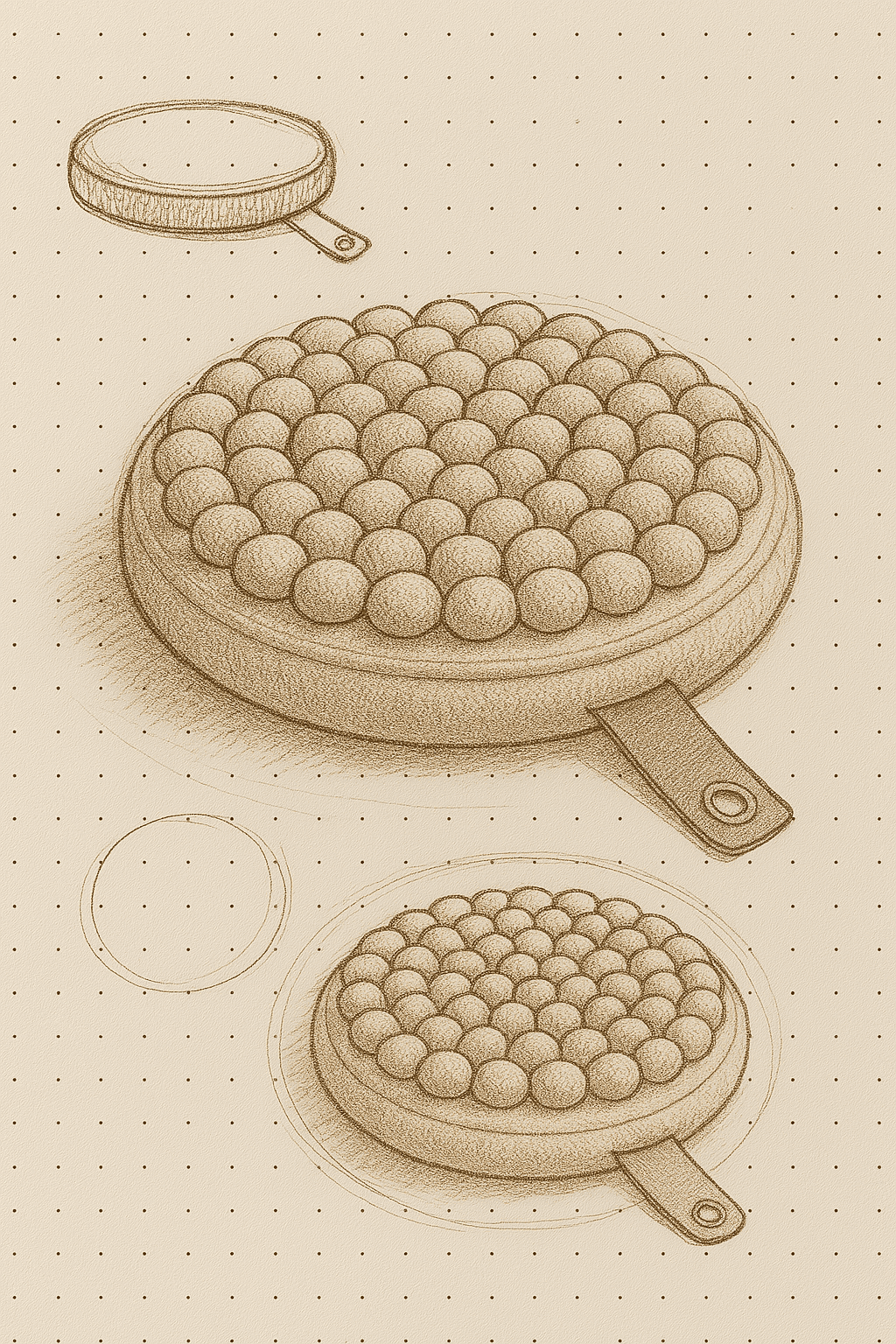
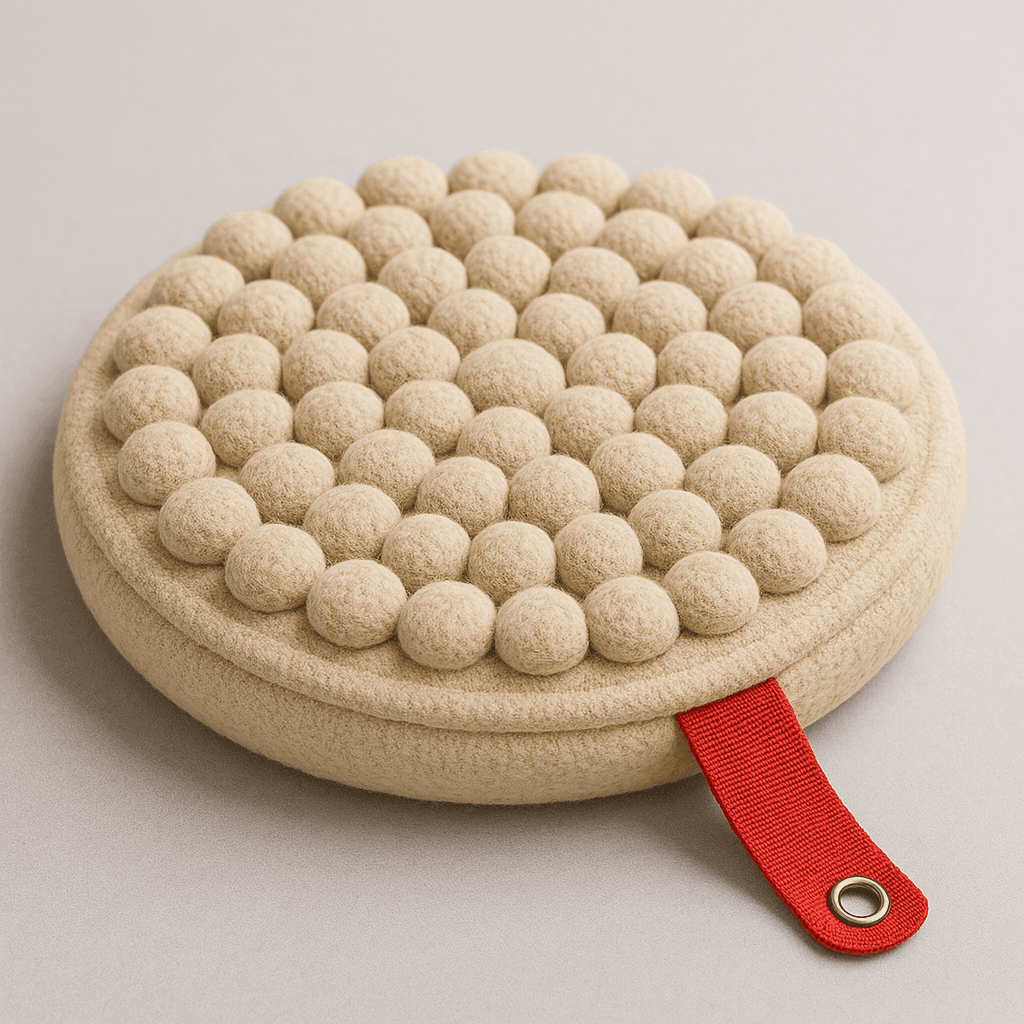
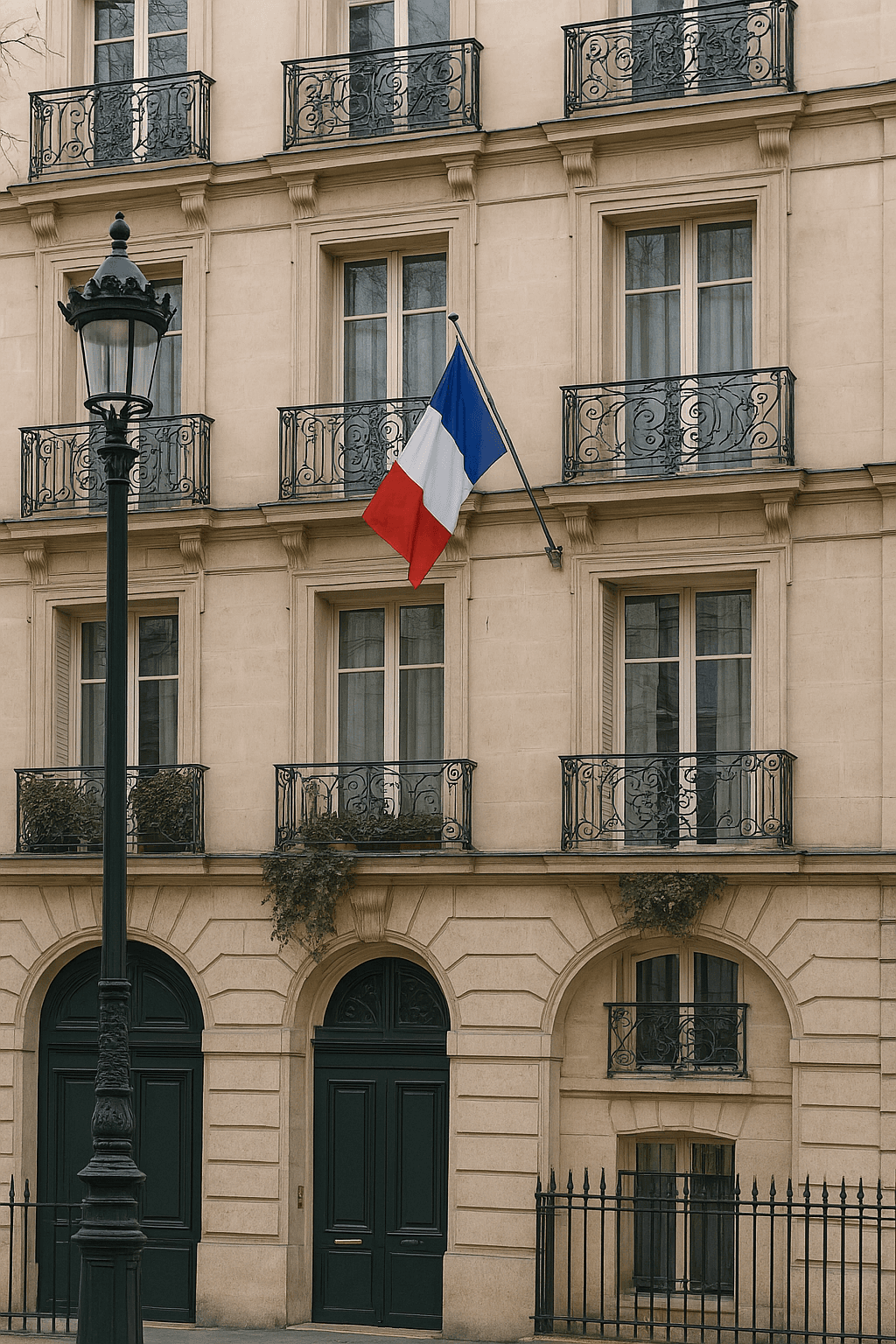
Every day in April 2025, I woke up, sketched a new product idea, took a picture of my sketch, wrote a prompt, and generated a full rendering of my idea. From idea to prototype in minutes. I then searched for the right factories with ChatGPT deep research functions. Some of the designs :


Tiny product challenge with Ran Segall
Glue entrepreneurs
Summary: Glue entrepreneurs
Are smart enough not to reinvent the wheel.
Build fast, listen to feedback and iterate.
Why create from scratch when you can glue?
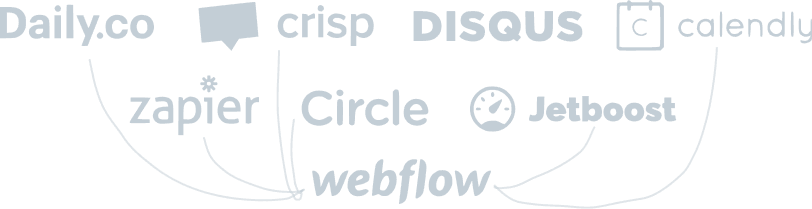
They bet on no-code, and are empowered by tools like Webflow.
Glue entrepreneurs plug, play and remix.
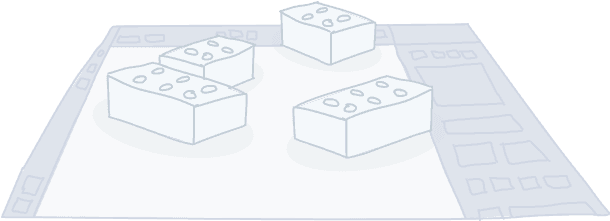
Go on ProductHunt, HackerNews, GitHub.
You'll see new lego blocks shared every day.
New APIs, new tools, new services.
Want comments? Add Disqus.
A feedback button? Add Canny.
Community? Circle.
So many lego blocks to play with.
No more starting from scratch.
But there's a caveat: if you can't code, you can't play.
The way of software
This is the way of software in the last 70 years:
mainframe computers split into hardware and software,
which split into apps
which split into APIs.
Software unbundled, specialized and mutated into a complex set of interacting pieces and protocols. It's a big messy puzzle.
For anyone in software, today's challenge is glueing it back together.
The more complex the puzzle is, the more specialized we have to be.
So say hello world to developers, who need to specialize in a few coding languages with a restricted set of use cases. Their job depends on their chosen speciality.
Adieu generalists.
Glue it all
Either software engineers start using common protocols to make integration easier. Or big companies use their leverage to offer 'open' platforms.
Multiple platforms are competing to be the "one interface to glue it all". And there is a word to describe this vision: "No-code".
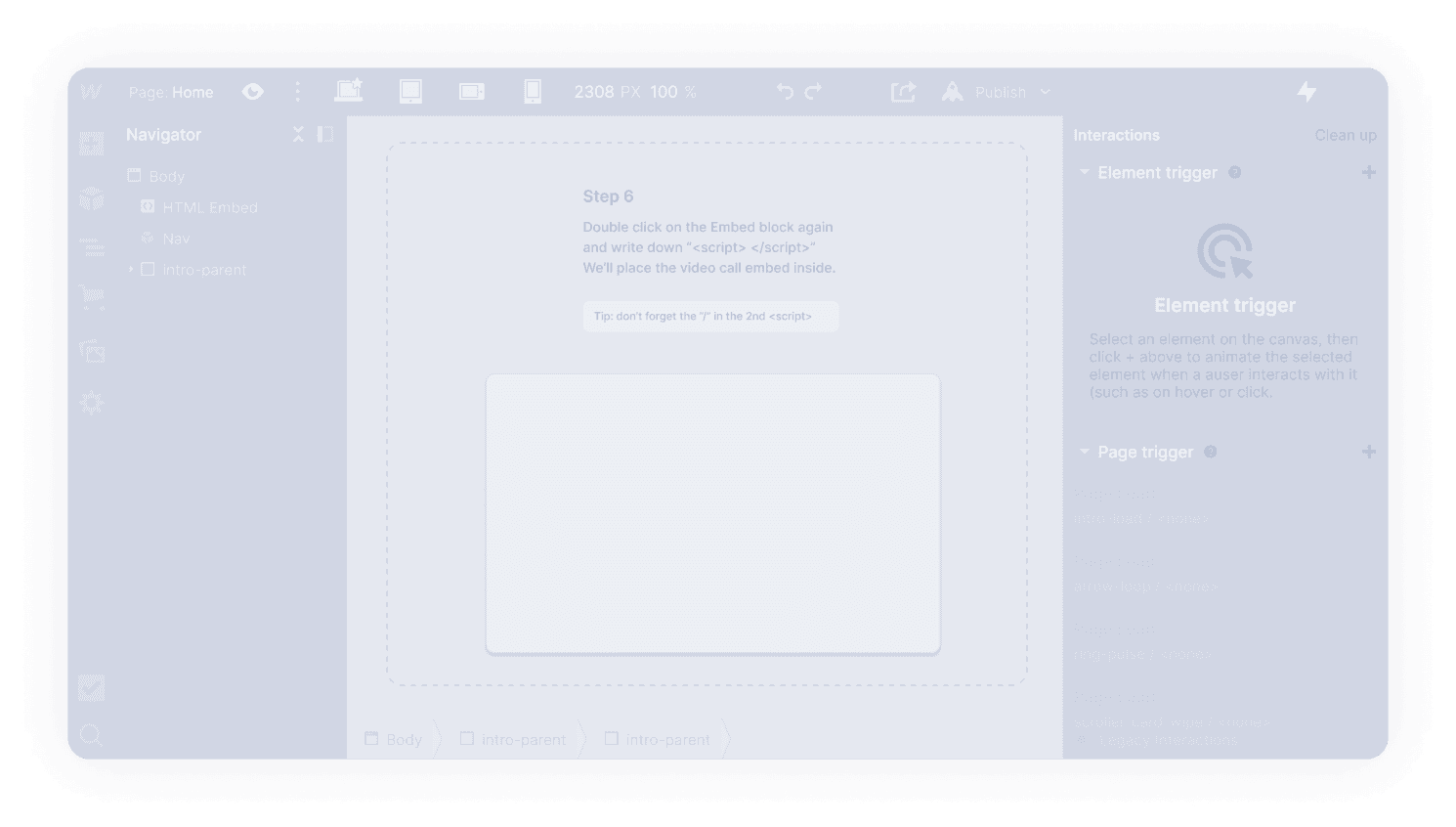
The No-code movement is exciting because it makes glueing all the pieces more approachable.
And perhaps "No-code" is a passing trend, a word that belongs to history books, where eventually most software is just built through intuitive interfaces.
But more importantly: no-code means we don't have to specialize as much.
And that's a good thing for people like me.
And I'm seeing a rise of this new kind of tech entrepreneur.
They're leveraging this movement to build their ideas faster.
The glue entrepreneurs.
Becoming Pareto optimal
Combine 'X' and 'Y' to solve 'Z' need for your customers.
Combinatorial innovation right here.
To meet market demands, putting up a solution using existing blocks saves time. With no-code, we can ship in dramatically shorter timeframes, by externalizing specific features to others.
And instead of overthinking technical specificities, we can focus on bringing business value.
The modern tech entrepreneur will have to be a glue entrepreneur: entrepreneurs have to be resourceful, and gluing with no-code is the Pareto optimal point to build ideas fast.
Betting on Webflow
Now, I'm betting on Webflow to be the leading tool for the Great Gluing. Here's why I'm bullish:
Webflow has the right tool, with the right balance between simple and complex
Webflow has the right company culture to build a platform that will last
Webflow has the excited community to accelerate it all. This article is a proof.
Bias notice: I was Webflow first intern 5 years ago. I've used the tool extensively and I'm teaching it now at university.
To recap, what matters now for a tech entrepreneur is knowing
what tools can be glued together
how to glue parts together
the limits of glueing, seeing the asymptotes and a Pareto mindset. The interconnectedness from bundling again: one should embrace and yet be wary of this phenomenon's consequences.
To help train a new generation of glue entrepreneurs, Supercreative is releasing a free tool today to learn how to no-code in Webflow. It's called Learnflow.
We're making the tool free to allow as many people to try no-code themselves. And you don't need a Webflow account to try it.
A new imperative
The "learn to code" imperative is becoming less relevant.
No-code means:
No need of funding for a first prototype.
No need of a technical cofounder.
No excuses to start.
All the pieces are here, available, for your new idea.
The "learn to glue" is becoming the new imperative.
Smaller barriers of entry = more people playing.
And that's very exciting for creativity worldwide.
Long live glue entrepreneurs!
15 habits to be organized as a designer
I have 4 apps on my mac that I use every day to organize my tasks, my time and my thoughts. These are Notion, Things, Day One and Spark. The goal of this post isn't to show you these tools, but rather the ways I'm using these tools. And out of the next 15 mental models and habits I'm going to share, maybe 2 or 3 will stick with you.
I'm Ben, I make products for creatives, and I'm constantly working on 10 projects at the same time. Right now I'm writing a book, launching a web platform, making videos every weeks, sending newsletters, teaching a course at University, shooting portrait photography, writing articles, reading 3 books, and trying to be a functioning human being. I have to be organized.
Other tools I love using:
Name | Description |
|---|---|
Arc | Web browser that's better than Chrome |
ChatGPT | My favorite intern |
Claude | My favorite copywriter |
Things 3 | To-do list app for Mac and iPhone |
DayOne | Journaling app |
Figma | Design tool |
Framer | Web design tool |
Notion | Note taking app for teams |
Whimsical | Visual note taking |
Remarkable | Reader that's better than Kindle |
Tella | Screen recording app better than Loom |
Beeper | All your chats in one |
Spark | All your emails in one |
Enpass | Save passwords |
Obsidian | To write and publish this website :) |
Limitless | Meeting transcription |
V7 Go | Excel with generative AI |
Instaprice | Pricing calculator for freelancers |
Cursor | AI-powered coding |
Midjourney | AI-powered visual generation |
Capcut | Video editing |
Hacker Feed | Reader for hackernews |
X | Still my favorite social network |
Raycast | App switcher |
Pitch | Presentations |
Supabase | Databases |
Windy | Weather tracker |
Raindrop | Bookmarks |
Browserflow | Scraping |
Limitless | AI transcriber. My experience |
Creative tempo (Part 2): Diverging, Testing, Converging
This is part 2 of Creative Tempo, a series to understand how creatives can become prolific by publishing consistently. If you haven't done it yet, read Part 1 first.
In Part 1, we compared different creative mediums and looked at their inherent tempo. We saw that playing on a fast tempo increases the chance of hits. We came up with a contextual definition of prolific creatives and the necessity to test different approaches for each new creation. The remaining question was: how?
How can we publish frequently? Frequently and differently each time?
Welcome to Part 2.
Diverging. Converging.
Underlying the publishing tempo of creative work is a pace. A constant pace between two phases: diverging and converging. We're either looking for new options or focusing on one.
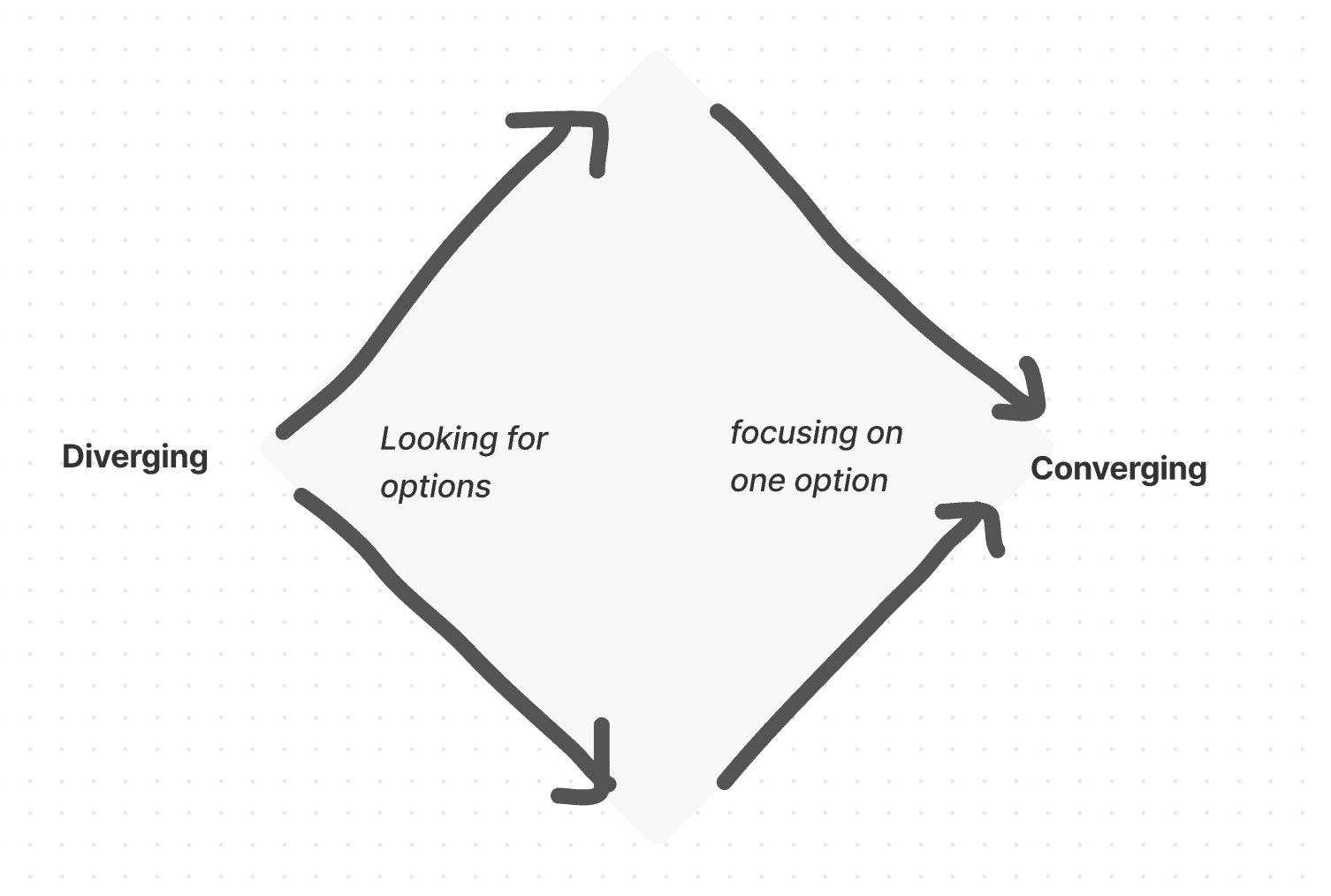
Our life swings, like a pendulum, between exploring options or exploiting the best one. Either diverging to new potential ideas or converging to what we think will work. Balancing these two modes is a tension we face all the time.When we're diverging, when we are exploring options, we operate in a relaxed, contemplative and playful mode. Contrarily, when we're converging, we'll have a goal to attain, adrenaline rushing, stress and perhaps a deadline to meet.We diverge to feed our heads with inputs, being "creative". We converge to use our heads on an output, being "productive". Breathing in. Breathing out. John Cleese talks about finding that balance quite elegantly with what he calls the Open and Closed modes.
Diverging longer, diverging better
Original work and ideas come from long periods of divergence. Diverging is difficult to do because we feel discomfort: we don't have deadlines, we don't know where we're going, we're just exploring. In our society, we've gotten really good at converging: focusing on outputs and productivity. Divergence is not clearly linked to outputs, the Return On Investment (ROI) is difficult to measure. So it is dismissed.And so we spend our work lives converging without exploring other options. But spending more time in "diverging mode" ultimately leads to more original work. There is a lot to learn from artists and scientists who become accustomed to the unease of divergence.
One way I've gotten better at diverging is by going on digital sabbaths, days where I turn off all my screens and just write in my room. I let my mind roam and explore new ideas. To spend more time diverging, Cleese explains that having a safe secluded space with a time constraint is ideal. On longer time scales, gap years are exactly this: plenty of time to explore options. In meeting rooms, teams will diverge then converge with brainstorming sessions.
The power of testing
Testing is when we eliminate options and choose what to focus on. It's what we do to go from diverging to converging.
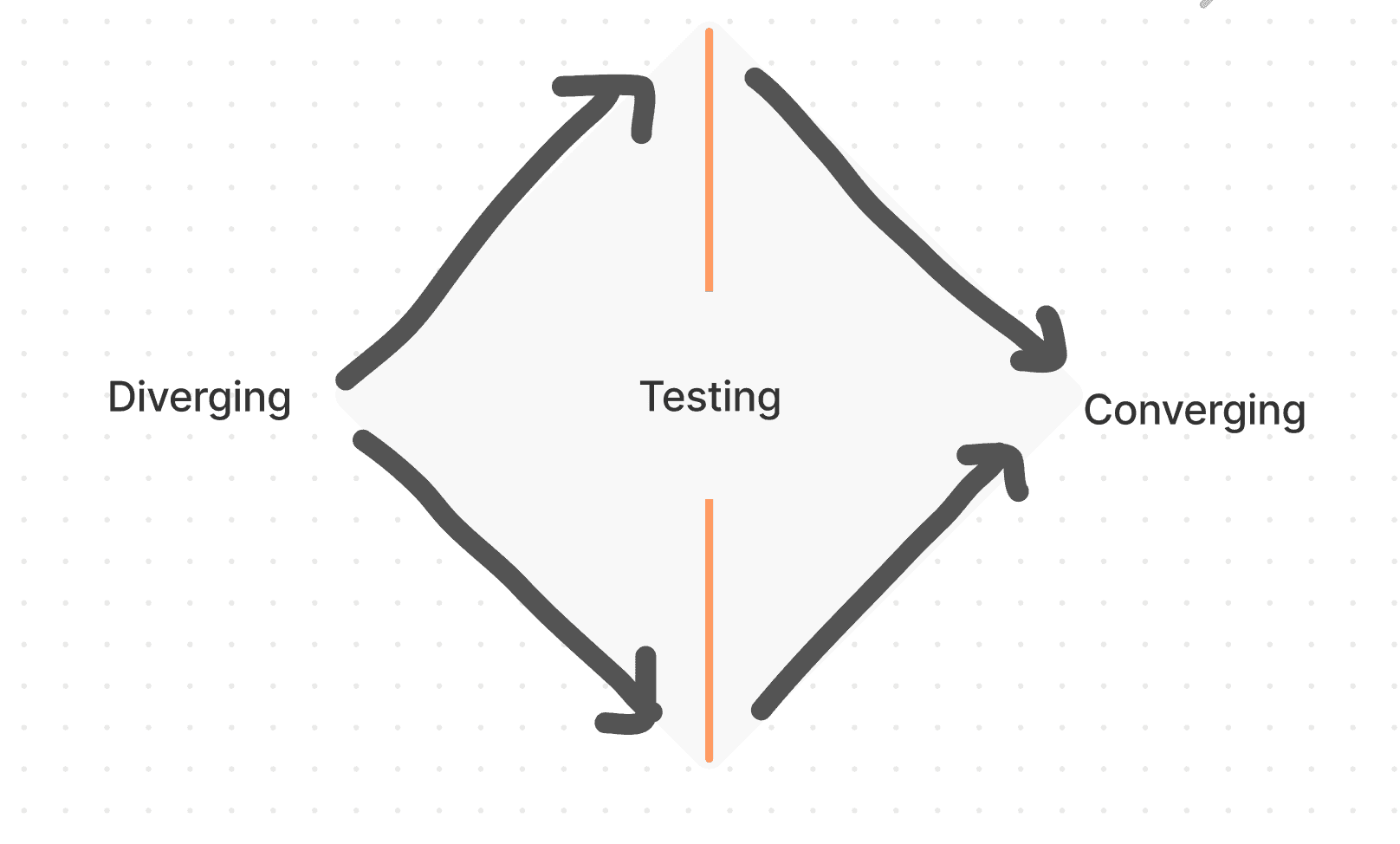
Testing can happen in many ways: in our heads, in conversations, in prototypes. Testing is a "fragile" moment, doing it prematurely and we might miss the golden idea, feedback can be demoralizing or misleading. So we tend to avoid it altogether. And we keep our ideas in our heads.
Becoming good at giving and receiving feedback, as I write about in ABC feedback, is a true superpower to get better ideas and shortcut the diverging/converging cycle. A good conversation can fuel us back with a different perspective and energy. To set the pace when I create, I set a fixed day and time to get feedback, to test my different ideas.
In addition, we should always be worry of our intuition: we tend to overestimate how successful our new work is going to be. In his book Originals, Adam Grant suggests seeking feedback not from our bosses but from our peers, who will are most likely to predict success or failure.
Deadlines against dead projects
To become better at converging, there's no one better to learn from than Steven Pressfield. In the War of Art, Turning Pro and all his ensuing books, Pressfield describes how we self-sabotage with excuses and end up never actually publishing anything. Instead of giving ourselves 3 months to "research" a new project, we should write our plan in an executive summary and stick to it.
To converge better, I think we can also learn from software teams and how they work in sprints. Reading Shape Up inspired me to create the tiny products model. The gist of it is simple: what can be created given a fixed time constraint? With most creative projects, we give ourselves "the time we need" to get something done. This makes it easy to procrastinate and never actually publish anything. We should work backward from a defined time constraint.
To become prolific, we need deadlines. For the last year, one way I kept up with deadlines was having accountability partners. Missed a deadline? Send your accountability partner $50.
The other way I made myself liable to converge was joining creative challenges. With a countdown, a clear objective, accountability, we just stop procrastinating. There's no better feeling than joining others who have the same goal and challenging each other.
Concepts covered
Diverging vs Converging: the underlying pace of creative tempo
Testing: in-between phase to diverge and converge
Digital sabbath: method to diverge better
Accountability partner: method to converge better
Creative challenge: set rhythm to converge better
To recap, we have shown that underlying the publishing tempo of creative work is a constant pace between two modes: diverging and converging. Spending a set amount of time diverging helps find more original ideas, while spending a set amount of time converging ensures we actually publish our work. By formalizing the testing phase between divergence and convergence, we can set a rhythm to get going. We can use tools like digital sabbaths, accountability deals and creative challenges to help us publish more.
Over the long run only creatives that have been consistent win out. Not missing a deadline, not missing a beat, is the most important thing. And when we "play on the right tempo", the tempo disappears and we start to dance. This is what Part 3 is about. To get it the next parts in your inbox, just subscribe below.
Creative tempo (Part 1): Setting the rhythm
QUESTION: How should we spend our time as creatives?
working a lot on a few projects (focus on quality)? Or
working a bit on a lot of projects (focus on quantity)?
ANSWER: the more works you publish, the higher the odds of producing a hit. This answer was arrived at by Simonton (1977) through the examination of the relationship between number of academic papers published and influence of their respective authors.
While trying to quantify creativity, Simonton named this examination the Equal-Odds Rule. It states that "the relationship between the number of creative successes and the total number of works produced in a given time period is positive, linear, stochastic, and stable." Put simply: the more you publish, the higher the odds of success. It has long been thought that focusing on quality is the path to creative masterpieces. But this is false, greatness is achieved through discipline of publishing a lot, frequently.
Publish or perish
The implication is simple but not easy: given that we can't predict our own success, we should just focus on publishing a lot, becoming prolific, and let our audience decide what is good or not. Becoming prolific is in our control, creating masterpieces is not. So how can we publish more? How can we become prolific, super creative? I answer this question in this three-part essay.
These questions have been on my mind for years, I have felt these tensions myself. I publish one article or video a week. As we inexorably become entrepreneurs of ourselves, I know many other creatives around me ask themselves the same questions. Analyzing the creative process from the perspective of creative tempo is new, and it sheds light on many challenges.
Based on this premise that we should publish more, I look at practical ways to systematically write, and I offer ways to measure the success or failure of these efforts. The level of abstraction of the analysis presented here is high enough, however, to be applicable to many creative fields. But the generalization of the following ideas will have to be further investigated.
Setting the rhythm
We describe someone as prolific if they produce many works, if they are highly productive. Being prolific is context-dependent: you are considered a prolific writer if you publish three books a year, but you are not considered a prolific photographer if you only publish three photos a year. Being prolific depends on the creative medium you chose and its associated intrinsic effort: publishing a movie takes a decade, publishing a photo takes a few hours of work. Creative mediums have different rhythms, different tempos. Some are fast paced -making TikTok videos- some are slow -writing a book. We can plot the tempos of creative tempos on a timescale like this:

We can go further and look at the average creations published for each medium. Let us call this measurement Creations Per Year - CPY. Though further (and more rigorous) research can be done here to provide accurate averages, it seems book writers have an average CPY of 1.22, meaning they tend to publish, on average, a bit more than one book every year. With IMDB data we can infer that the average feature film director has a CPY of 0.18.
Change the tempo
To become prolific, you can then either
pick up a creative medium that has a faster tempo (instead of writing a book, write a blog). How do you think you can go from slow tempo to fast tempo if you're inexperienced in that medium you chose?
try publishing more than the average CPY (publish 3 books in a year instead of 1 like the average). What is the average CPY of the medium you're interested in? Do you think you can keep up or exceed that tempo?
Creative thoughts emanate from our own minds. And though we are influenced by others, creative work is still a single-player game. But when we play on fast tempo, we can get more external feedback and improve continuously. Slower tempo mediums, those with low CPY averages like book writing or filmmaking, are harder games to play. When the tempo is slow, you have less opportunities to get external validation, funding is harder, the potential to mess up is higher. I think it's a good strategy to start with fast tempo to publish more and hone a style, and then move to slower tempo games when you have experience.
Becoming super creative
Being prolific is necessary but not sufficient. CPY is an output measure which doesn't capture outcome or impact of the work published. In this regard, it could be disregarded as a vanity metric. However, the underlying assumption here is that each time we publish, we improve or try something different than last time. We need to learn from each iteration and be creative. We cannot simply do the same thing over and over again. To be super creative (productive and creative), we should assume that for each creation: we refine our technique, push the boundaries of our skills and learn from each iteration. And counter-intuitively, as I explain in Part 2, we need moments of divergence, of exploring ideas instead of creating to create more.
Concepts covered
The Equal-Odds rule
Slow vs fast tempo
Creations per Year, CPY
Acceleration of tempo
To recap, we've shown that creative mediums have tempos, and that to increase our odds of success we should publish frequently, on a fast tempo. Yet amid this imperative to create prolifically, we need periods of exploration. This is what Part 2 is about.
Over the long run only creatives that have been consistent win out. Not missing a deadline, not missing a beat, is the most important thing. And when we "play on the right tempo", the tempo disappears and we start to dance. This is what Part 3 is about. To get it the next parts in your inbox, just subscribe below.
A theory of what makes something interesting
In a research paper from 1971, Murray S. Davis gives a bold answer: interesting ideas are those that deny certain assumptions of their audiences, while non-interesting ideas are those that affirm them. An idea is not interesting because it's new or thought to be right, but because it challenges what we normally believe.
It is denial of some truth, not the creation of a new one, that makes an idea interesting.
I think about this paper frequently. Generating good ideas is not enough, ideas have to be interesting, especially when the knowledge we create become more abundant and we fight for attention.
Here's my summary and take of Davis' paper "That's Interesting!: Towards a Phenomenology of Sociology and a Sociology of Phenomenology"
The 4 steps to be interesting
Take a commonly-held belief
Deny it
Explain why
Provide further consequences
A recipe to generate interesting ideas is to look at common assumptions about your subject, say it's wrong and provide good reasons for it to be wrong.
Example
I'm personally interested in freelancing. So a claim I can make to be interesting is the following:
Freelancing is a great way to be more free (you choose your clients and times.)
But that's wrong. The dependence of managing clients is even more stressful than employment.
That's because your performance is more directly tied to you
Furthermore, being self-employed means a lot more admin work than if you worked at a company. You have to work more. It also means you work more on your own, and loneliness sucks. The lure that freelancing equals freedom is so deceptive, that most people end up going back to regular employment after a few years.
That is more interesting than if I affirmed the claim that freelancing = freedom.
12 ways to be interesting
According to Davis there are the 12 categories of interestingness, all formed around the same structure: “we thought that X, but actually Y”. Here's my visual representation of his categories:
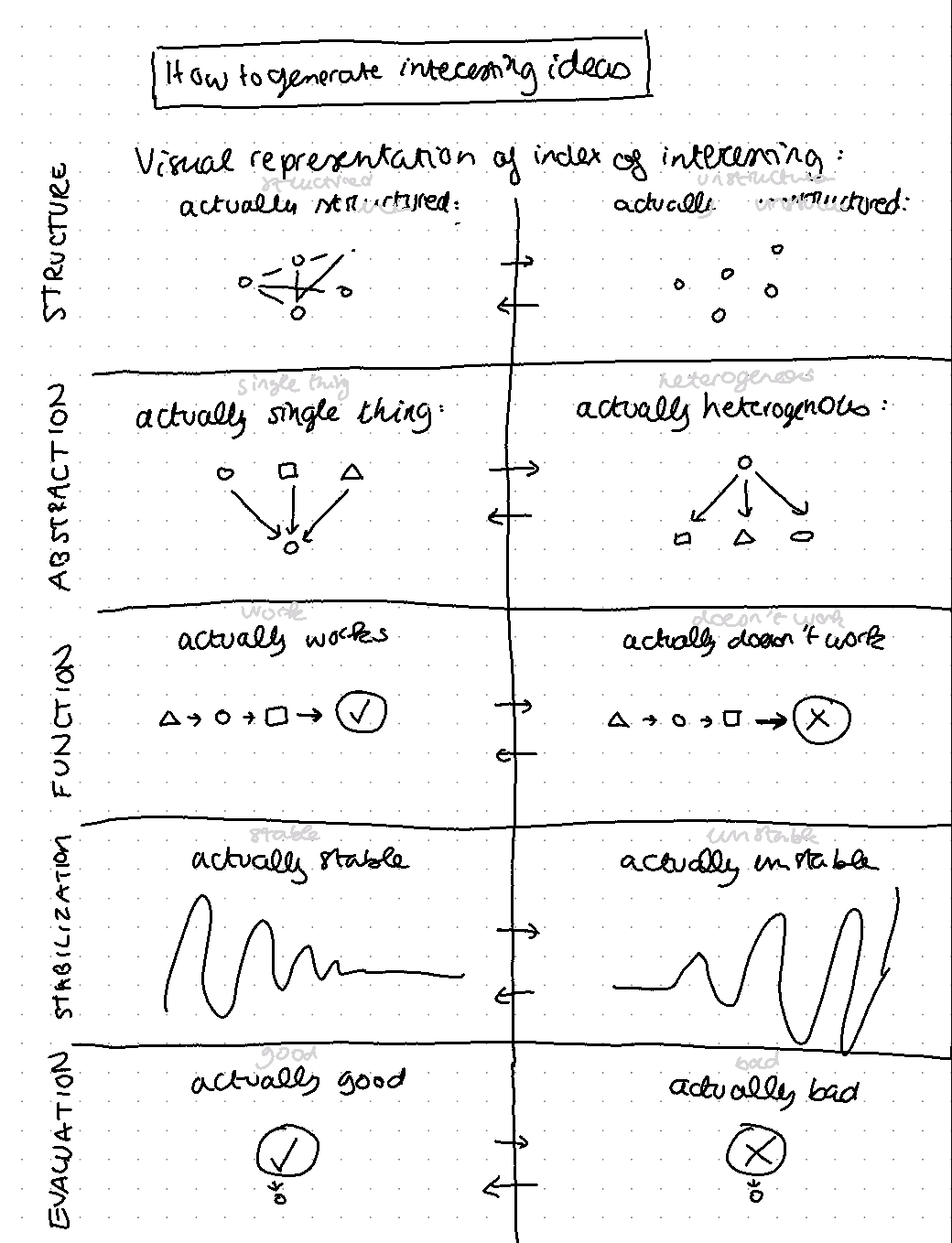
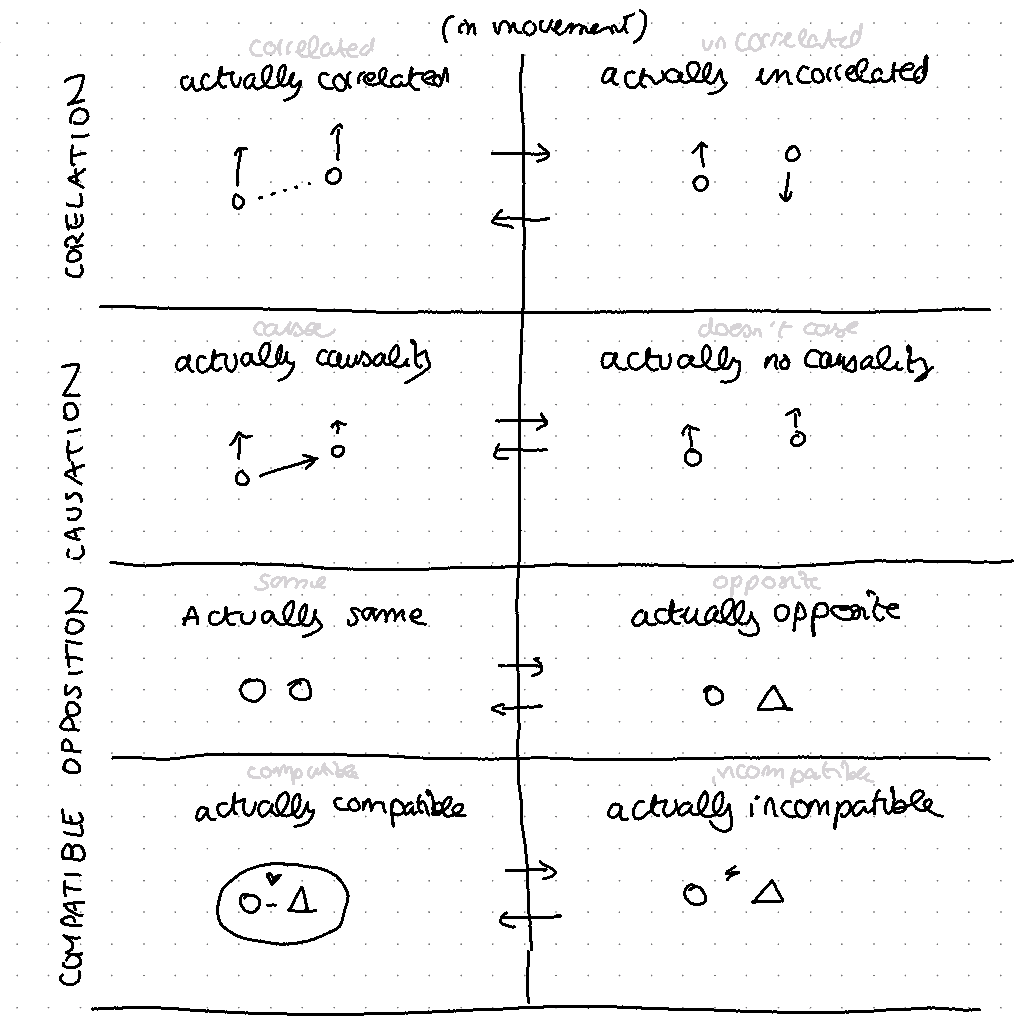
Example from above, under Evaluation: "Large breakfasts are good for your health", prove the opposite to be interesting.
The 2 conditions to be interesting
You need to know who your audience is and what their assumptions are about your subject. The more clear your understanding of the commonly-held assumptions, the more striking your denial of it.
The subject at hand must be important for the audience. If a belief has no importance, no matter how interesting the denial of it, the argument will stay boring.
This means both an understanding of the topic, and the understanding of other's perception about the topic.
Time of writing: May 2023
ABC framework: How to give better feedback
The problem with feedback
Most feedback we get is just terrible. Empty affirmations, futile suggestions, demoralizing comments. If the path to improving is feedback, but feedback hurts, we just won't want to improve. As a freelance designer and creative, feedback is a big part of my work. So we need a way to guide feedback, to make sure it helps more than it hurts.
So to improve feedback, we should start with our emotions (what I call emotion-based feedback). Let me explain. We humans are constantly making judgements about things around us. We first have an emotional reaction and then we make up a reason for that reaction. Our first reactions are always.. reactions, not thoughts.
But when we give out feedback, we tend to suppress those initial reactions and jump directly into reasons and theories for why something should be improved. This is a mistake. We obstruct feedback by not revealing one crucial information: how we feel.
To guide feedback we should start with feelings. Every time we give or seek feedback we should ask: What is Awesome? What is Boring? What is Confusing? And finally, for the last missing letter, what is Missing? It's easy to remember: ABC.
What is awesome?
So first question: What is awesome about that work? starting here, with the Awesome, just starts feedback on a positive note. Here you should share what you find exciting, what you think is worth doubling down on. The delivery of feedback is as important as its content. And great feedback is energizing, it gives us a renewed sense that our work is worthwhile, a feeling of improvement. When you share that enthusiasm by asking "what's awesome", you're making the other person an ally, not an opponent.
What is boring?
When we ask this question, we get information about what to remove. The perceived objective of the creation is thus clarified: what's boring doesn't serve as much towards achieving that objective. The creator thus has to think about managing expectations, [being excited here]ù creating small moments of delight, or just cutting out the unnecessary.
What is confusing?
Then, what is confusing? This question brings conversations about clarity. Clarity in our work should always be the priority. It's the designer's first job, and thinking about the information hierarchy - what's most and least important in our work - dissipates potential confusion. By asking about the confusing question, we'll get feedback to be more consistently clear. In my experience, asking what is confusing always brings me many great ideas to improve.
What is missing?
As opposed to the boring question, which usually prompts us to remove the unnecessary, this question helps us feel the gaps. Ultimately, there are many more reactions that can be shared. But in my experience, focusing on the awesome, boring, confusing and missing reactions are sufficient.
But we shouldn't stop at these reactions. We should connect these reactions to specific parts of our creations. Pinpointing what in the work made us feel how is the key to then suggest improvements. SO first we need to 1. react then 2. connect our reaction to the creation and then 3. suggest improvements. This makes feedback specific, practical and therefore useful.
Different levels of feedback
Finally when we seek or give feedback, we should clarify the perspective we need. Do we want 1. zoomed in feedback? 2. Zoomed out feedback or 3. Reframing feedback? Let me explain...
Zoomed in: When we're giving zoomed in feedback, we're looking at the details, noticing small specificities... Typos, misalignments, rough edges. The devil is in the details. Here's an example: [need to record Yannick's voice] "Ben, in this video on the two first minutes, I was bored because you forgot to add sounds here and there, and so I wasn't as engaged".
Zoomed out: this is the high level perspective, looking at the broader context and overall direction. High level doesn't mean it should be vague, it can (and should) be as specific as zoomed-in feedback. Here's another example [need to record Yannick's voice] "Ben, I'm excited because this video fits with your overall theme of becoming Supercreative, I think that's awesome".
Reframing Finally, when we're reframing, we're switching perspectives entirely and looking at the creation from a new angle. This can lead to valuable insights. With reframing feedback, we can realize that the work we've created has value in entirely different fields. Here's a final example: [need to record Yannick's voice] "Ben, as an engineer, I can tell you I was a bit confused with your interpretation of feedback, perhaps explore the writings of Rosenblueth?"
SO stating which level of feedback we're giving or looking for - zoomed in, out or reframed - is useful to clarify the type of feedback we want.
Going further
To become feedback masters we should build a habit (or set reminders) to give and seek feedback frequently (maybe once every few days or weeks). There are tons of people you can ask feedback to: your friends, family, colleagues or on Fiverr. Preferably, by being in an environment where everyone is open with giving and seeking feedback, we improve more. This is what I'm trying to build right now with Supercreative challenges. In 1983, a study by Bandura and Cervones on cyclist show that when you couple frequent feedback with clear goals, you can expect your performance to improve by three times. [source]
Finally, there's that trap most creatives fall in. When we have more experience, we seek less feedback because of social pressures to appear confident and self-assured. But there's always room for improvements. And I believe that with ABC questions and the right perspective, we can keep growing.
Moodboards as a creative escape
My prison
I locked myself in my bedroom for a year. And I became a robot: I would scroll the same social websites, read the same news, and think about the same thoughts over and over again. I'd be stuck in my room, and stuck in my head. My life became predictable and boring.
On August 20, 2020, I'm diagnosed covid positive. No symptoms. But 3 months later, my toes turn red and start itching uncontrollably. I google it up: I'm one of the rare cases of covid toes. Bizarre. I want to get out. I want to chase mysterious thoughts. The world is getting weird, I wanted to get weirder. My 2021 resolution became to follow strange gods.
The escape
On February 4th 2021, internet user @jbfja releases same.energy. Based on ideas developed at OpenAI. this neural network is being fed 11.9 images every second. It scans the whole web and links images based on their content and style. This is the escape I've been looking for: a weird place that becomes weirder, if you want it to. So I clicked, and clicked and clicked.
As I descended down the hole, and I fed my head, the Algorithm was fed too. Two beasts in different bodies: the mind and the software.
In the stillness of my room, my mind created new worlds. I became a scavenger of the unfiltered imagery the web had produced.
Controlled chaos
Confronted with this semi-controlled chaos, I couldn't resist but to structure it more. I opened Figma and started copy/pasting my discoveries. And every day for two weeks, without doing the work I was supposed to do, I scrolled same.energy and curated my explorations in mood-boards. Spiritual, cyberpunk, psychedelic: I indexed and assembled all these moods that fascinated me.
Symbiosis
What I experienced with same.energy is a new form of symbiosis with software, where the mind and the algorithm synchronize themselves on the same wavelength. This is a new type of cybernetic experience. And as I was stuck in the pleasant limbo of visual explorations, a thought occurred to me. In this last year of being locked in my room, I was never actually bored once. The feeds and notifications were making sure I wasn't. My life was boring, but I was never bored.
"The mind organizes the world by organizing itself" (Jean Piaget - 1973).
Following strange gods led me to remote ideas. But I was never able to let go of the organization and predictability of my mind.
Tiny products
Deadlines against dead projects
The biggest problem is not finishing what we've started. Our mind is our biggest enemy. We self-sabotage, we seek shiny new things, we lose interest, we create unnecessary complexity, we procrastinate. It's hard to ship a project when we can always add more, explain more.
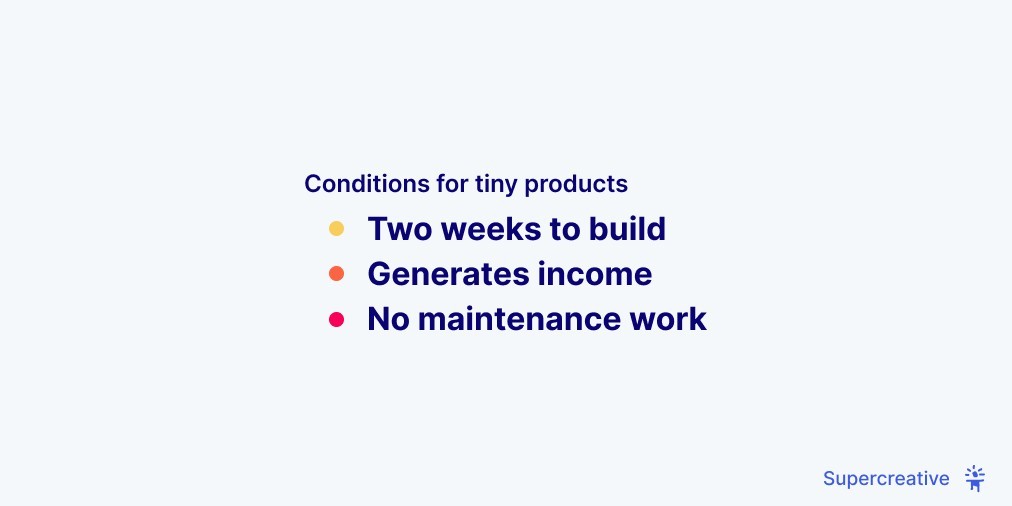
But when we have a deadline, all of a sudden we have to make decisions. Insignificant details get left out. We have to make concessions. The project gets shipped. Starting with a time constraint is, in fact, a creative constraint in the design process. Especially as we become solo, indie, freelance makers with no bosses, setting ourselves a deadline isn't natural. But deadlines make projects live.
Short cycles to shortcut intuition
Our intuition is shit. What we think will succeed probably won't. Spending two weeks on a product reduces the risk of putting too much time into a bad idea. We're terrible at predicting the future. Because here's the untold story: you don't decide what's good and what's not, your audience does. And when we understand this, our job then is to feed the funnel.
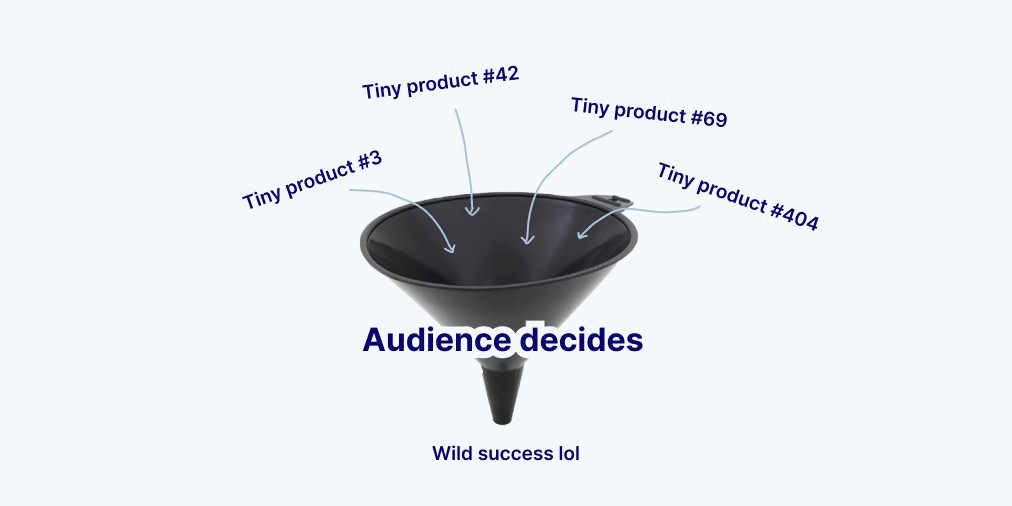
It is to keep on creating. Every day. It is to push stuff into the world consistently. To trust the funnel blindly. To have faith in the maths of success. To ship creations we might not even be proud of, but let our audiences decide what creations turn into creatures, taking a life of their own.Oh and short cycles are fun: lots of launches, lots of adrenaline.
Income generation to gauge value creation
People pay for things when they are valuable to them. Asking people to pay for what we create is the best way to know if you've actually made something that is valuable. The validation is infinitely stronger when someone buys your product instead of just committing to buy it. So the income generation condition incentivizes for making valuable things. A tiny product that doesn't generate income shouldn't be called a tiny product, it's a hobby. The goal of Minimum Viable Products is to learn. The goal of a Tiny Product is self-sufficiency.
More shots, less moonshots.
Cool kids want to start startups. Cooler kids now want to hyper freelance. What happens when we scope ambition down? Just shipping something tiny that has value? Tiny incremental progress require less willpower, but if you add it up over time = aggregate > working on hugely ambitious projects.
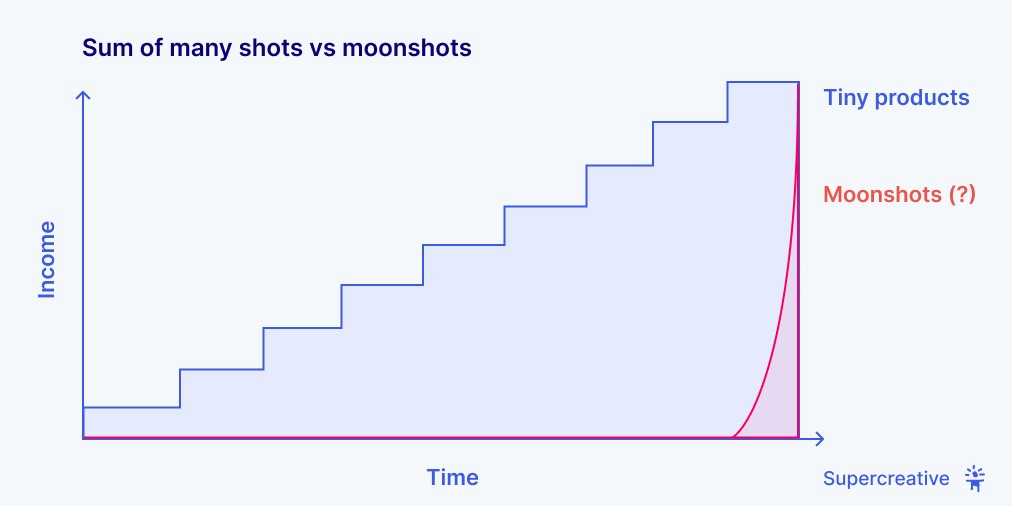
That's how great things start. It's much easier to double down on something that already works than working blind-fully on moonshot project. This goes against the predominant Silicon Valley stories, perpetuated by Marc Andreessen, Elon Musk and co, though they were exactly the ones who worked on tiny products early in their careers (and then doubled down on what is already working, creating a "big vision" along the way). As Daniel Vassallo or James Clear would say, build a "portfolio of small bets" instead. Play games where you can take many shots, less moonshots.
Tiny products out there
Notion Pack is a tiny product: Notion templates for freelancers. 2 weeks to build and launch, $15k of passive income, zero maintenance.
Supercreative Radio is a tiny product: Curated playlist of French touch music. 2 weeks to build and launch, $200 of income, zero maintenance.
EarlyName is a tiny product: SaaS to reserve usernames. 2 weeks to build and launch, $200 of MRR, zero maintenance.
QRCreator by Levels.io is a tiny product: SaaS to create restaurant menus from QR codes. 2 Weeks to build and now launching and monetizing, zero maintenance
Other hyper freelancers have their own tiny products, from selling templates to courses. Thousands of apps in app stores are tiny products. Hundreds of website templates are tiny products.
Big strategies for tiny products
So let's say you're interested in creating tiny products. And you're also thinking about the meta game of creating and owning many tiny products. This is an infinite game: to keep on playing you have to keep shipping. Some questions to ponder together:
When is it time to switch from exploring to exploiting our portfolio of tiny products? It takes intuition and being in touch with our feelings and motivations to know when to double down on products with most traction. But most of us want to keep exploring. I'm in the process of hiring a remote assistant to focus on this.
Can we compound the success of previous tiny products to new products? By default no one cares about you. Launching constantly get easier with an audience. For every tiny product, collecting emails is probably the smart move. Attention is malleable: you can channel it toward any future product. New launches instantly have potential. You're just an email away from a flop.
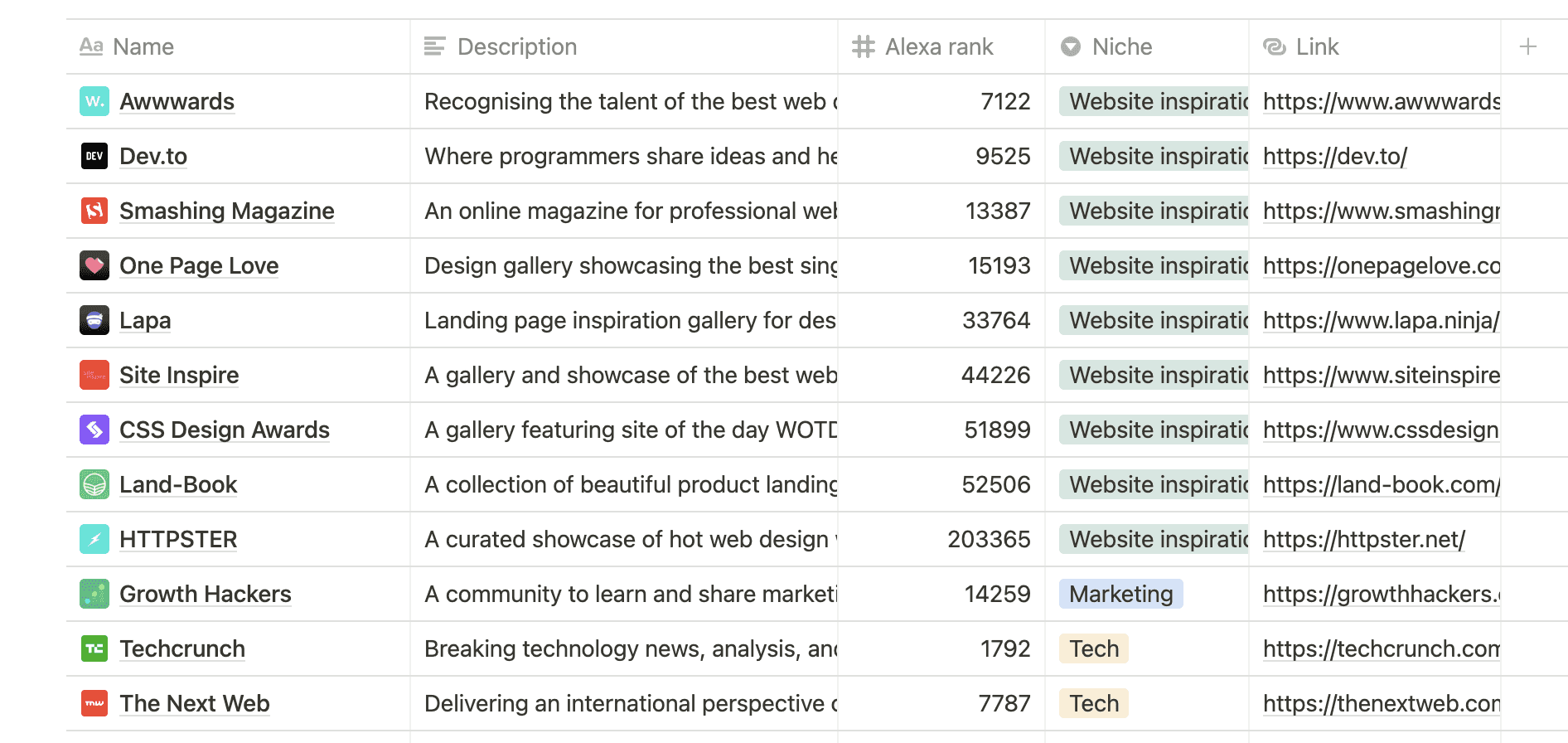
Is "build in public" worth the effort for tiny products? Yes. Sharing what you work on means validation and feedback more often. So you don't have to wait two weeks to know if your idea will fail. Document what you work on, share your process, tweet it.
When should we kill tiny products that aren't succeeding? We don't have to. If we don't maintain any product, it's better to keep something online than deleting it for the sake of it. What we should funnel our attention and efforts to instead are killing ideas before we make them products. Most ideas shouldn't be built.
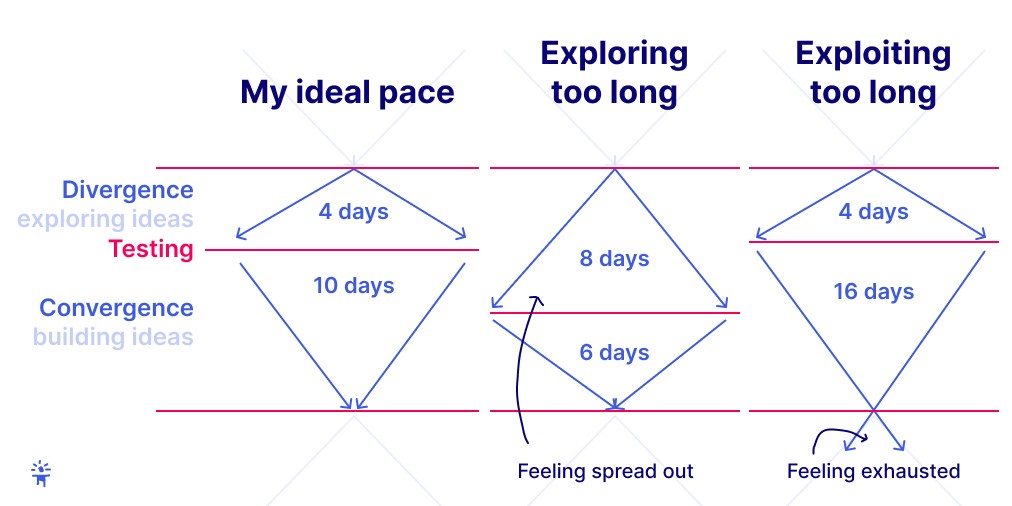
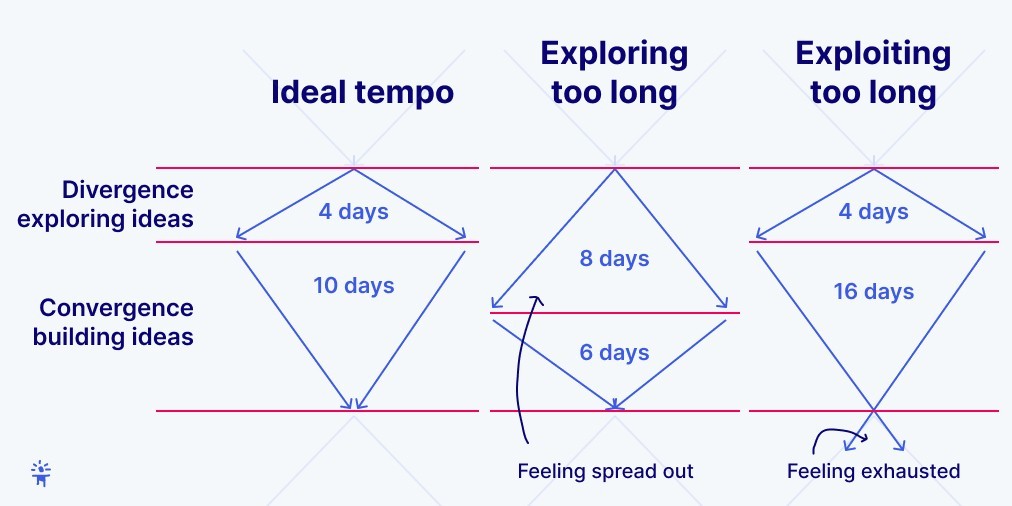
How can we find the right tempo to switch from ideation to creation? Though two weeks is short, my difficulty so far has been to spend too long exploring concepts for a tiny product (thus feeling too spread out) or spending too long on exploiting an idea recklessly with no validation (thus feeling exhausted). Mastering my tempo is crucial to play the long game.
Why are tiny products now possible? Because no-code. Because everything is turning into an API others can plug into. Because the tools to design, code and launch ideas that we now costed thousands a decade ago.
Now, my question to you: can you build a tiny product from the current project you're working on? What would it look like? How would it work? How would it make money? Even though it might not seem possible to bend your project inside the conditions of a tiny product, try. Right, you think you can't build products? Challenge yourself to ship one, that's how we learn. Not fantasizing about the required skillset, just building and shipping products. Finding time between clients or juggling with a job. It is possible. Just create every day.
Further readings
The Basecamp boys published Shape up last year with two inspiring ideas: working in six weeks cycles and the concept of appetite with fixed time, variable scope. A great free book to read in an afternoon. Though it's pretty unbearable to read, Nassim Taleb's Antifragile talks about creating optionality to better support shocks. Reading a summary is probably smart. I'd also encourage watching YC's startup school video about continuously launching. Finally, I wrote an article about a model where freelancers combine consulting, education and products, and tiny products are directly tied to these ideas.
Subscribe to the blog to follow how I'm living by my own terms, creating the lifestyle of a super creative, leveraging the internet.
The Monthly Investor Update
Each month I send an email to a dozen friends and clients. The email shows, in a few bullet points, how the Supercreative business is going. Revenues breakdown. Failures. Hiring decisions. Monthly objectives. This is an investor update. Yet I don’t have any investors. Why would you do that Ben?
Here is what my Monthly Investor Update (MIU) looks like:
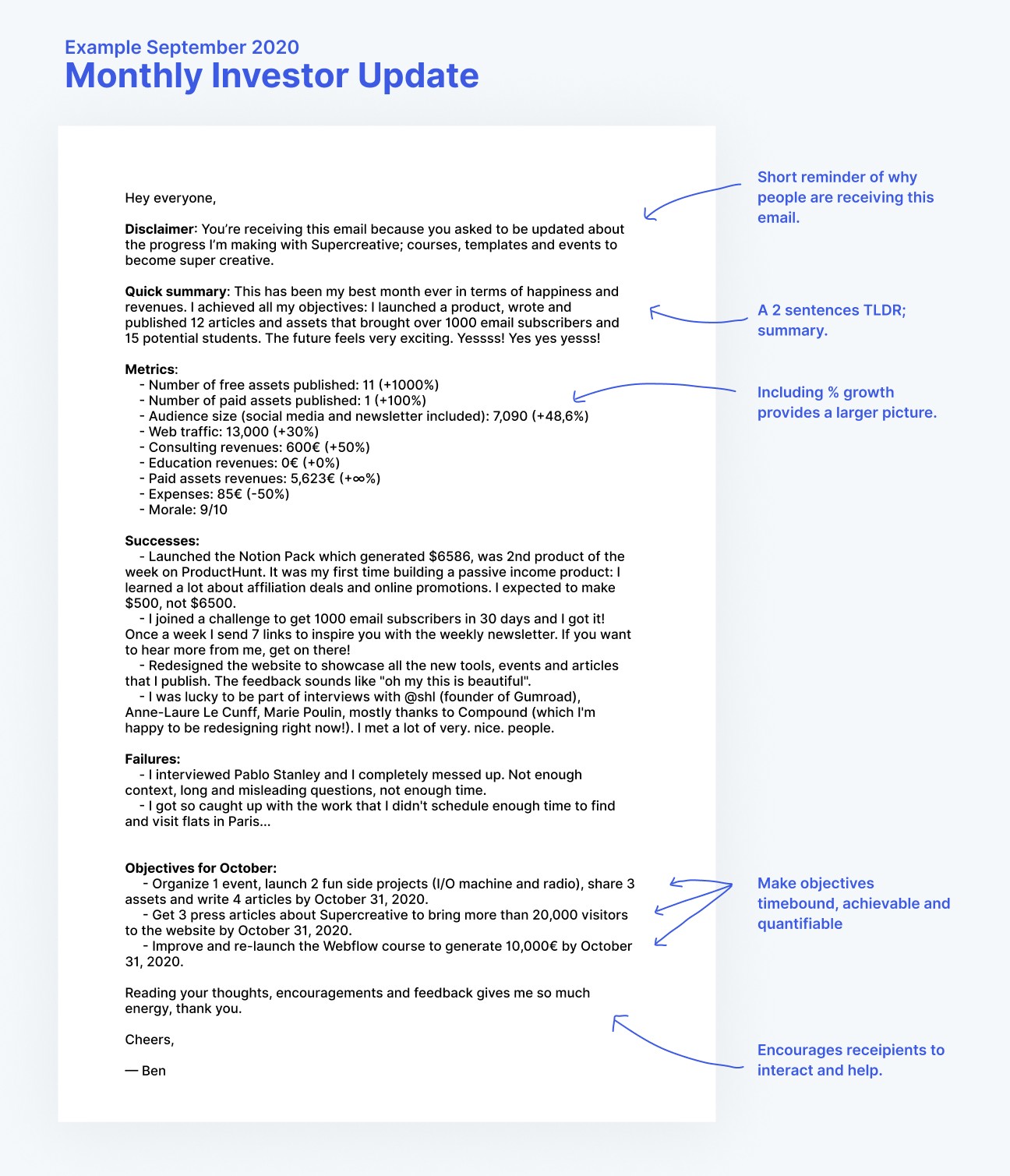
Investor updates are a fantastic forcing function to deliver great work:
Stay focused: a monthly recap is a good way to assess what's failing and double down on what's working. It's forced introspection. It sets the rhythm for continuously improving. In my experience, I tend to achieve more when I set myself a monthly tempo, not quarterly (too far and vague), not weekly (too fast, not enough data).
Stay accountable: freelancers don't have bosses, we're entrepreneurs of ourselves. Writing and talking about an objective crystalizes it: you'll have to do it out of fear to disappoint others.
Create serendipity: by letting others know what you're doing, they're more likely to mention you to the right person at the right time. Frequent updates create luck. Thanks to my monthly update, Olivier and Savi worked with me on Supercreative.
Create transparency: finally sharing your MIU publicly brings more advantages. Public companies and open startups do this, some indie hackers do too. Freelancers should be next. Being more open about what works and doesn't would push many to learn faster (charge more! charge for your calls! specialize! sell your strategic thinking!). Sharing our process and building in public doesn’t require a lot more effort, it creates trust and consolidates the idea that we're experts. I gladly show how the sausage is made.
A few strategies for great MIUs
Simplicity
I pretend my update recipients are low time & attention executives, it’s an investor update after all. I write with simple bullet points and I start with my conclusions. I remove the BS and superlatives. This makes my MIU punchy and straightforward.
Even though my monthly investor updates are public, using emails make them feel more personal and drive more engagement than putting them on a social network or a blog. My first 6 monthly updates were just emails I sent with the default email app. Only recently, with hundreds of people following my updates did I decide to move to a newsletter service like Convertkit. If you're on your way to hyper freelancing, building up a newsletter is a solid way to launch new products, courses and keep clients in the loop.
Writing my MIU generally takes me one hour. Writing it is simply a transcription exercise. The reflections about last month’s metrics, and creation of the next objectives are a bigger creative endeavor.
Metrics
What should you track as a freelancer?
If we are what we measure, it’s crucial to take the time to think about what metrics to focus on.
With multiple iterations, I’ve landed on tracking revenues by activities (consulting, education and products), leads and conversion rates, average project size, audience size and morale.
Though morale is self-reported, it’s still a metric I wish more freelancers and entrepreneurs tracked because it begs the question: am I enjoying the journey? Will I still be after many monthly iterations?
Let the numbers and graphs tell the story. Impress with execution.
Projections
Something magical happens when you write down where your future self will be: it becomes reality. This sounds childish, vaguely inspiring or self-help-like, but it's true. Projection works.
Formulating smart goals - specific, measurable, achievable, relevant and time-bound - drives us towards execution. Don’t write “I’m going to have more clients” as your next month's objective. Write instead “Get 20 leads and convert 2 by October 30, 2020”. The formulae “[Action verb] [measurable thing] by [specific deadline]” is powerful. Personally I've been immensely driven by my objectives, so this is where I spend most of my time when I write my MIU.
Closing remarks
If you're starting your own MIU, send it to me and I'll gladly subscribe. You can also subscribe to my own monthly update and watch me build a successful creative business. I share almost everything.